The AI diffusion trade
I truly believe that for any operator joining a startup, be it early stage or late stage, they should, as much as possible, build a view, an opinion, an investment thesis on how this company sits: either in the stack of other builders or in the stack of the wider economy.
So, I joined Notion. During my first week, I heard Ivan say: "Venture Capitalists don't need to be right 10 out of 10 times. They need to be right 1 time out of 10. Founders need to be right n of 1."
The same is true for employees, if not more so. That's why I don't see an operator at a startup as just an employee. I see you, the operators, in a way, as an activist investor: you build the company, but you also invest in it with your time (not to mention the cash to exercise your options, etc. etc.).
There are multiple intangible reasons why I joined Notion. The very first one, as cliché as it might sound, is really the people. Before joining Notion, I'm joining this team. The talent density is almost scary here, and it motivates me and anyone joining to just stay on their toes. I cannot believe that I'm going to have the honour and privilege to work with folks like Amelia, Adam, David, Nathan and Max and many more. Seeing this level of talent density at such an old (yeah, compared to other AI startups, 13 years is 'old') startup, is so remarkable. It's absolutely insane that I get to see these folks operate- that I get to learn from them and work alongside them.
Now, my thesis: Notion is not a software stock. I know, I know, I am biased. The wider world still sees Notion as a notetaking app. But that's the beauty of it, isn't it? That's how I started using it. That's how millions of people across the world started using it. There's something magic and artistic about that, and it's exactly why I've loved the product and the brand for as long as I can remember.1 Notion has no reason to be mad that people became fans in its first era, the notetaker era.
Taking a step further, counter-intuitively, that incomplete, reductive notetaker label is also a good thing- yes, even from an investment perspective. I know that the company wants to position itself as an AI company, and this makes sense because the AI talent density is incredible.2 See the recent acquisition of ZeroEntropy and the teams of Sarah Sachs, Geoffrey Lint, and more. Therefore, yes, Notion is an AI company. But I might get in trouble for saying this: my view is that Notion is neither a software trade nor a pure AI trade. It's something better than both: an AI diffusion trade.
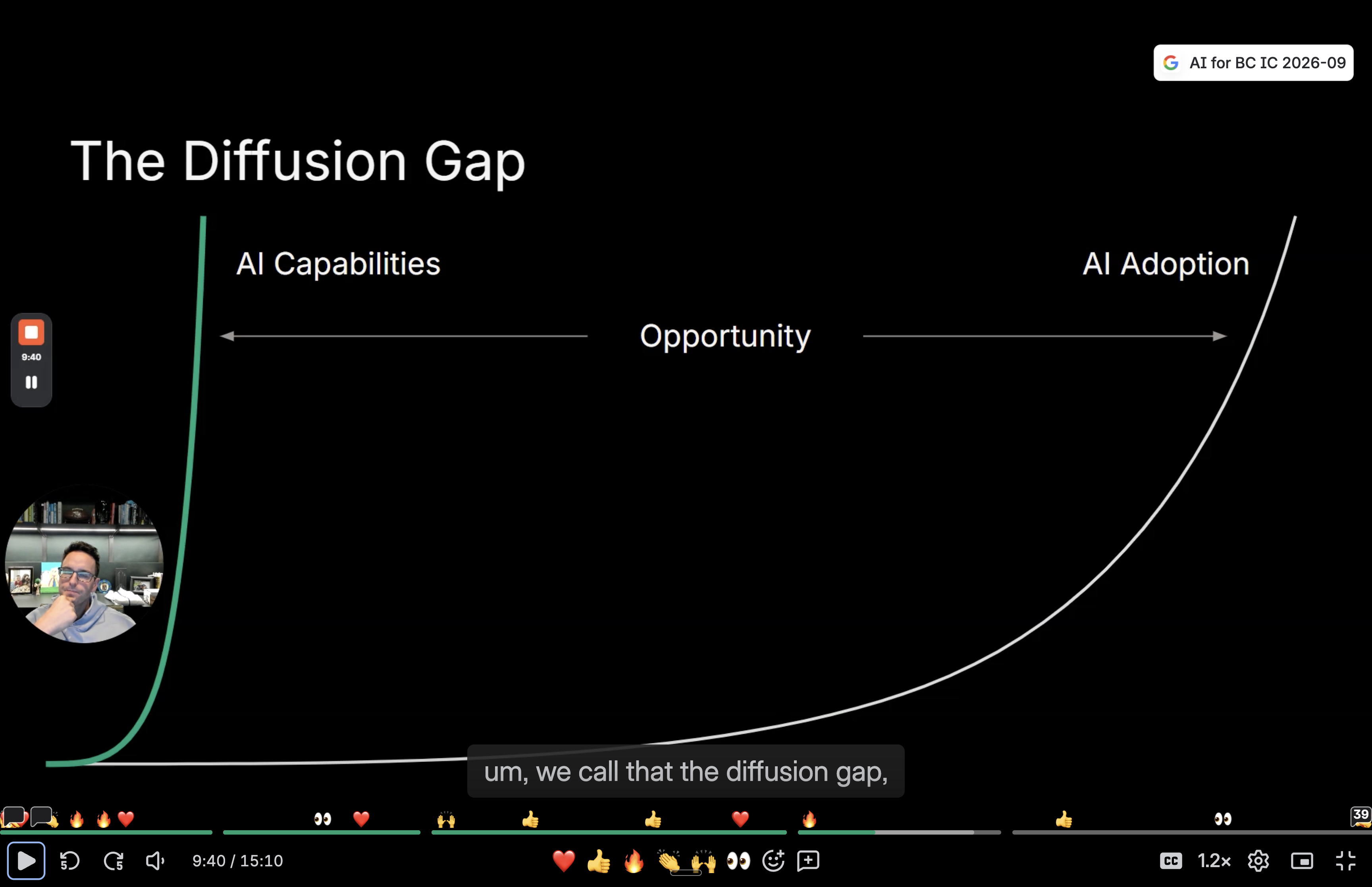
I spent the past years working in the AI transformation market and advising multiple AI transformation founders, so I know it well. The ugly truth is that AI transformation companies are a short-term trade, not a long-term one. Almost all of them are in a race to the bottom: the big labs, with their own DeployCos and internal FDE shops, will quickly absorb most enterprise use cases into the models' capabilities.3
Also: there are only so many enterprises.
On the other hand, I've been watching the rise of holding companies closely. They take a long-term view on both investment and implementation, which is refreshing: Long Lake, Thrive Holdings, Bending Spoons, Ithaca Holdings. That's great, but they still won't reach the wider economy.
They can only acquire so many businesses.
So what's the solution to the AI diffusion problem in the wider economy, if services firms only cover the short term and holding companies can only acquire a finite number of businesses? So how do you reach, at scale, thousands and thousands of small and medium-sized businesses4, across the global economy? Oh well, if only there was a piece of software already used by thousands of small and medium-sized businesses, that also happened to already be also enterprise-proof and enterprise-grade. Something production-grade, already proven at scale, that could also be a window for AI use cases. If only there was something like that. 5
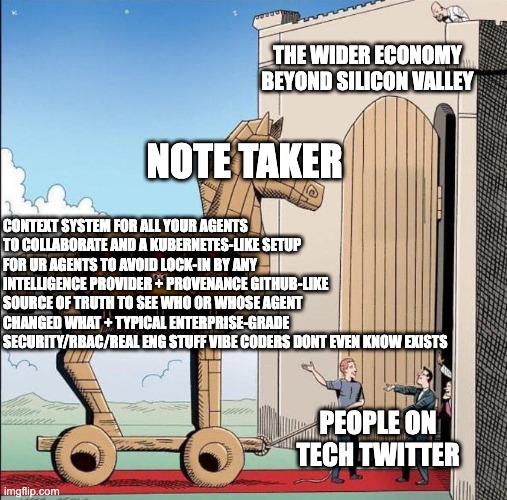
And this is where I might really get in trouble: the notetaker is a perfect trojan horse. It's how Notion closes the diffusion gap in the wider economy and gets AI working, usefully, inside small and medium-sized businesses, beyond the top 500 companies. Nothing wrong with also focusing on the F500, enterprise is definitely an important focus for any company, Notion included- and it's great for those F500 to hurry up and become ai-native, it's great for the S&P 500 and for all of our 401(k)s.
However, with AI (call it AGI or ASI), we should be much more ambitious than just aiming for an index in the stock market to go up.
Our ambition needs to be bigger than that: it should be about any sovereign GDP to go up.
So far, we only talked about one kind of builder: the software builder. Developers have their stack: Codex, Claude Code, Cursor, Linear, Conductor, Devin, and more. But most businesses out there aren’t software businesses. They’re the restaurants, the shops, agencies and services businesses at large that make up most of GDP.
So what’s the stack of the real-world builder, the solopreneur, the business owner with five thousand, or five hundred, or fifty, or five employees? From how I see it: Stripe, Shopify, Ramp, Mercury, and Notion. If being a pretty notetaker is what gets AI into those businesses, I’ll gladly let the world think Notion is a notetaker.
Abundance- that’s the promise of AI I believe in. I am self-made and come from a lower-income family, so maybe I romanticise this too much, but AI shouldn’t only make the shareholders of AI companies richer. It should make everyone richer, and help any small business thrive, not just the Fortune 500, but also what Akshay refers to as the ‘Fortune 5 million’. So, here’s to moving GDPs.
I am absolutely thrilled to be joining a group of artists with beauty in their minds, fierce ambition in their hearts, and craft in their hands.
Let’s make something beautiful.