The importance of a (or many) Switzerland(s) in AI
On trading floors, the Switzerlands of AI, and keeping your company's alpha.
Two trading floors
I started my career as a trader. The finance world is split between trading floors at banks (JPMorgan, Goldman Sachs, Bank of America, etc.) and trading floors at hedge funds (Citadel, Bridgewater, Two Sigma, etc.).
The trading floors at banks specialise each trading desk in a specific product. Example: I was a trader. My jurisdiction was bonds. Not inflation trades or swap trades, but bond trades. Not stocks, not equities. Bonds. I could occasionally express my view with other products, but I would then affect the of other traders, so I would need permission.
The trading floors at hedge funds: any tool needed to express a view is fair game, for anyone at the firm. The goal is to just make money. And actually, many folks confuse these two types of firms as competitors: they are not. As a bank trader, hedge funds are your clients. Your job as a Goldman Sachs trader is to provide to the market, the market being hedge funds.
I see this formation in AI
The intelligence providers
You have the big intelligence providers: OAI, Anthropic, Google, Microsoft, Meta, Grok. Each now has a that wants to sell its specific product and its specific intelligence to the market. However, the client has a lock-in. If a client works with OAI's FDEs, they get to use only OAI products.
The “wrappers” products + AI services firms
On the other side, you now have these: AI-native products (think: Flora, paper.design, Conductor, Cursor, Devin, Notion, etc.) and these services firms, like AI transformation firms. The client of these does not have any lock-in, because, on the one hand, the user of the product gets to pick the intelligence that serves them best, and, on the other hand, the AI transformation firm gets to use any product to satisfy the need of the client. Any. The goal is to just make money for the client.
Let's take it a step further in the services world. For a client, this is better, because they get to have the best models at the best price. They don't have the time to follow the AI market. What is the latest model release? And the prices? They don't care. They care that AI moves the needle on their business. And the AI transformation firm here can act essentially as a and act in the best interest of the client: at times pick Astra, at times pick Sonnet, at times pick an .
Again, some folks might confuse the FDEs of the intelligence providers with the FDE shops of AI transformation firms and think they are competitors. That is not the case. The AI transformation firms are clients of the intelligence providers. Do you see the parallel I see now?
A Switzerland. Or multiple Switzerlands.
This is why we can't have a fully consolidated market. OAI and Anthropic can't and should not acquire everything. It is just physically not possible and, frankly, bad for market structures. So, let's now finally get into the title of this article: the importance of a Switzerland, or multiple Switzerlands, in AI.
On the services side
Personally, if I was a client, I would work with AI transformation firms that are labs-agnostic: small shops like Eliza and Ciridae, and medium/large-sized shops like Tribe and Tenex. There are indeed a lot of reputable AI transformation firms that are lab-led: Ode with Anthropic, and OAI's Deployment Company. But as a client, I would be terrified of a lock-in.
On the product side
What products out there allow me, as a client, as a user, as a beneficiary of intelligence, to be the owner of, and have over, my own ? Definitely the first ones that come to mind are the coding tools: Devin, Conductor. And of course, so many other AI-native products - this is why I put quotation marks on “wrappers” above: suddenly, “wrappers” are actually much more appealing to users than ever. If a creative wants to create, they can do it in Flora with any intelligence of their choice, and not be constrained to only one or a few intelligence providers. And with this, let's now take a step further and understand what happened with Cursor.
Cursor and OAI
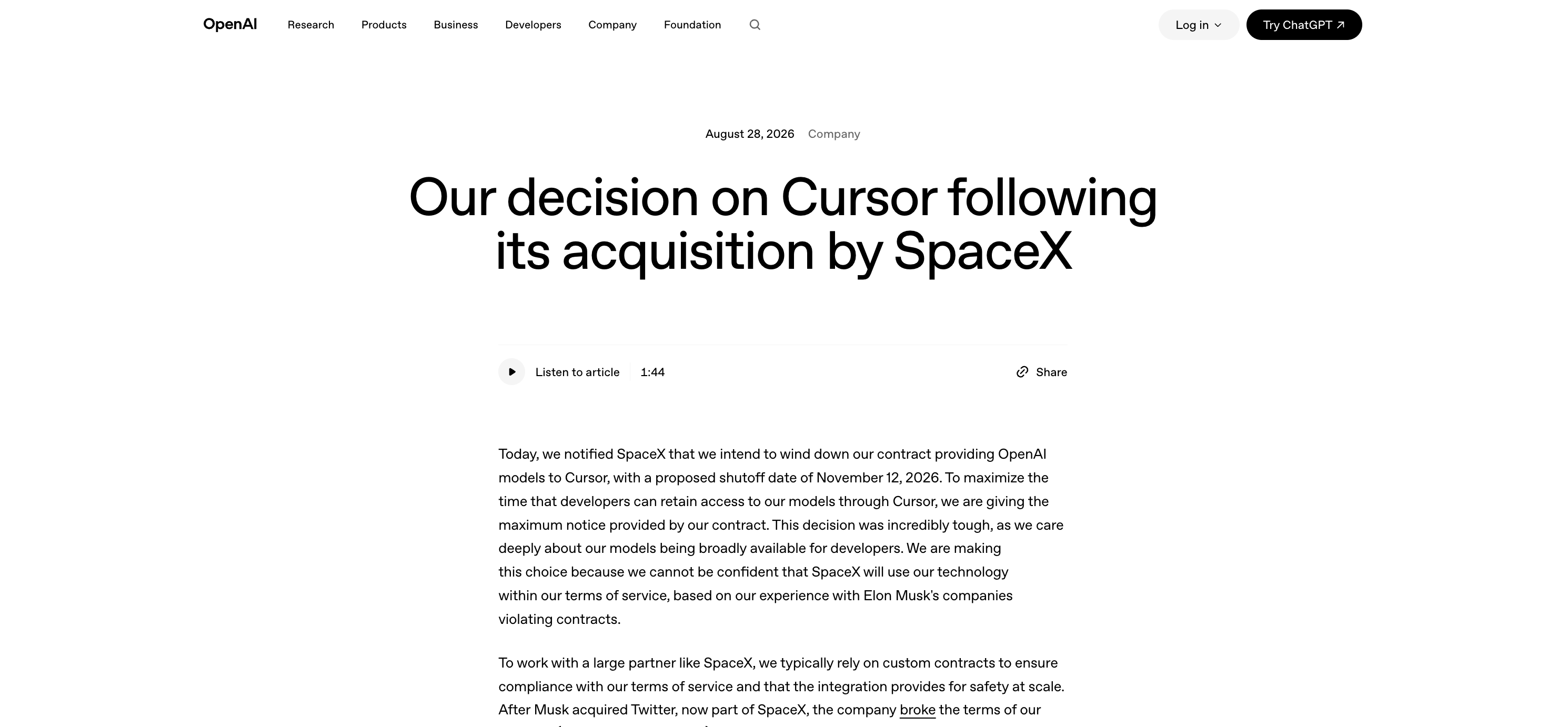
Cursor used to be on that list too, and what happened to it makes the stakes especially clear. Following its acquisition by SpaceX, which also owns xAI, the company behind Grok, the question became whether those different intelligence providers would still be available inside the same tool. On August 28, 2026, OAI announced plans to end its agreement supplying models to Cursor, proposing November 12, 2026 as the shutoff date. It also said it would withhold future models, citing concerns about whether SpaceX would follow its terms of service. For the user, this is a problem: you choose a coding tool like Cursor in part because it brought different providers together. But as we see from the Cursor/OAI situation, if this tool is acquired, it can lose access to an intelligence provider after a change in ownership.
For the users, we love and need competition. Competition is good for users, because we get to have the best of the best, at the best price, at all times. It's the one beautifully designed feature of capitalism.
What will be the GitHub for knowledge work?
Now, software engineering work is not the only thing that benefits from AI. Clearly, knowledge work at last is the actual goal, and where a bigger slice of the GDP lies. And this takes me to Notion. Notion has been criminally underestimated as a product in this AI wave. And, from my perspective, it's about to have its moment. Let's first, though, take a step back and break down the following: why did we have such a frenzy and AI psychosis with AI for coding agents?
A repo is a folder
This whole coding agent frenzy took place because, turns out, agents really, really like to work with . Directories. What is a ? A folder. What is a ? How folders are inside other folders. Turns out that a repo is this: nothing more and nothing less than a folder with many files and folders inside. What does this mean? That there is a series of paths, a tree, a structure. A structure that an agent can follow. This makes it easier to navigate a series of files and information, and come back to you with value: code that solves a problem.
company-brain/
├── clients/
│   └── acme/
│       ├── meeting-notes.md
│       └── proposal.md
├── playbooks/
│   └── onboarding.md
└── decisions/
    └── pricing.md
Knowledge work is text too
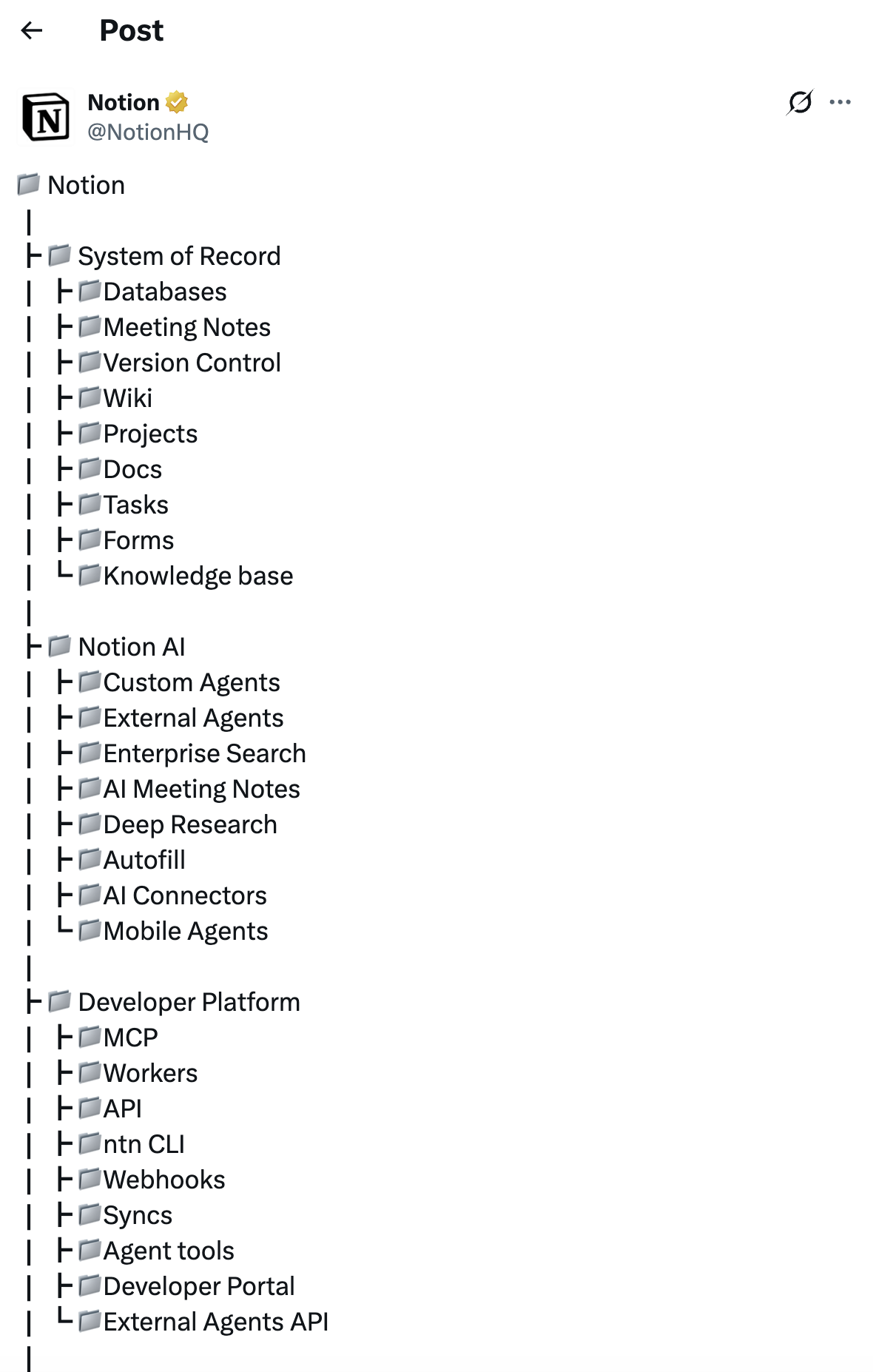
Coding agents worked really well on code for 2 reasons: code is text, and agents really like clean, tidy things (like directory structures). Now, what if we could replicate this clean and tidy environment, but for knowledge work? Let's not forget, knowledge work is text too! Most white-collar work is literally paper pushing - how can we make this also as structured as a GitHub repo? What will be the GitHub for knowledge work? Notion is extremely well positioned to be what Cursor was, but for knowledge work. And they seem to be taking a step towards this.
Context as proprietary alpha
In finance, we care a lot about . Here, I am using it to mean the advantage that is actually yours. For a company, from my perspective, a lot of that sits in its context: what it knows about its clients, why it made certain decisions, the things it tried that did not work, the workflows its people have spent years figuring out. Anyone can rent the same model. They cannot just rent those years of knowing your business. This is your proprietary alpha, what people now like to call the company “brain.” Why would I want to rebuild it every time the best model changes? I want to bring intelligence to my context, let it do useful work, and keep what makes my company my company.
In that sense, Notion is that GitHub for knowledge work, offering what a tool like Cursor offered for coding: instead of having a repo, a repository, for you to code on with Cursor (meaning any coding agent: OAI before, Anthropic, etc.), you have your company brain, your company text, for you to work on with Notion agents (meaning any intelligence provider: OAI, Anthropic, anyone).
The value of intelligence is not to code more
With this in mind, AI transformation firms that are labs-agnostic should also start adopting and deploying products that just work, instead of vibe coding things from scratch all the time. The value of intelligence is not to code more. I think we have been mistaken about that as an industry. But maybe it's to take the company context we already had, restructure it, tidy it up, and make some actual dollars out of it from intelligence.
Who I hope to see standing tall in 5–10 years
In this new world, I hope to see hopefully multiple Switzerlands of AI stand tall and not get acquired. In this specific case, Grok bot and Cursor are perfectly complementary, and already I feel like I can't live in a world where they are not together. I will write another blogpost/YouTube video on how I use Grok bot and Cursor to code anything, at any time, and remotely. It's an incredible product marriage and an extremely successful merger from a product perspective. Therefore, in this specific case, I'm so happy for the Cursor team. A generational run, incredible for the founders, teams, and investors. But at the same time, from a user perspective, I hope not to see a sweep of too many acquisitions of this kind. Not all acquisitions lead to such a perfect marriage of complementary products. And a sweep like this creates an environment of swallowing and consolidation that prevents clean and ruthless competition and cost-cutting that ultimately benefits me, the user.
Who I hope to see standing tall in 5–10 years: on the product side, Notion, Conductor, and Devin (Cognition). And on the AI transformation side, at least some of the lab-agnostic shops.
Essentially, as a consumer, I want the intelligence providers to compete for my business.
The same way that, if I am a hedge fund, I want traders at different banks to fight for my business.
And I want my company's alpha (what people call its “brain”) to remain mine.
If you are working at any of these companies, or have any takes, please feel free to reach out to me at vitoria@vitorialima.com. These are important conversations and discussions that I have been having with tons of clients and practitioners in the space, and I'm always eager to have more coffees and croissants around the city.