
The Short Decade
NYC, November 2026
I have been writing this as of September to November 2026. Tons has happened since November 30 2022, the date that ChatGPT was released. As I write this, I feel like that in these past 4 years, 40 years of progress have been packed.
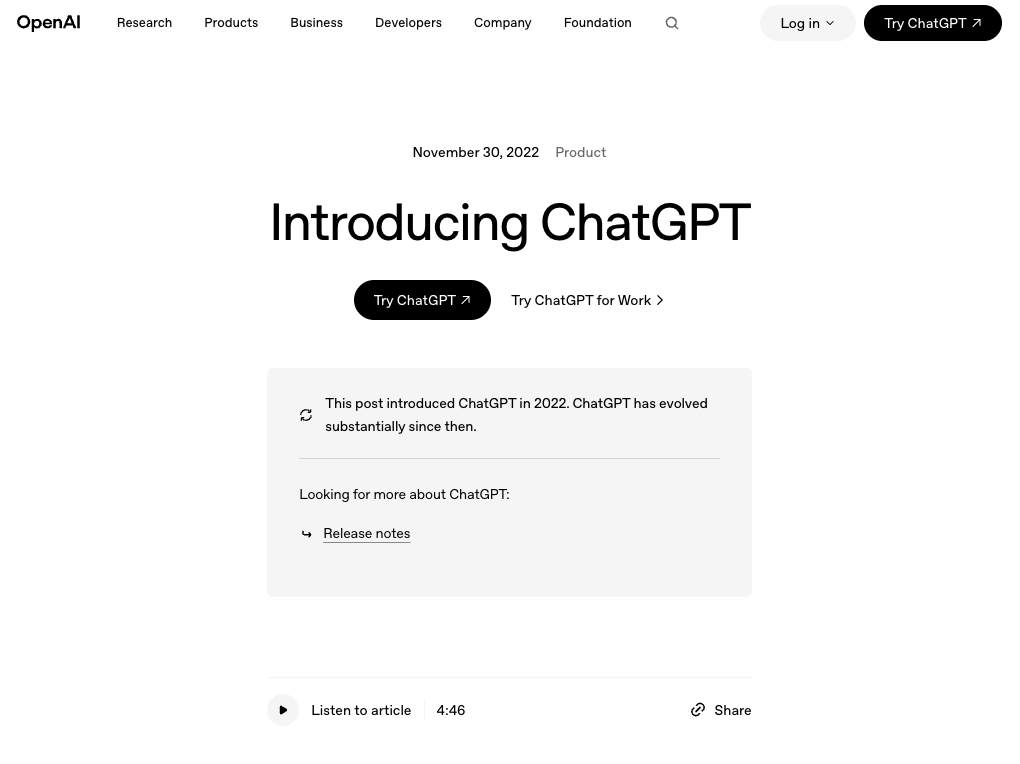
As I write this, I feel like that in these past 4 years, 40 years of progress have been packed.
We went from a chatbot, released as a free research preview, on November 30th 2022, to Jensen Huang calling Astra the first version of on September the 6th 2026.
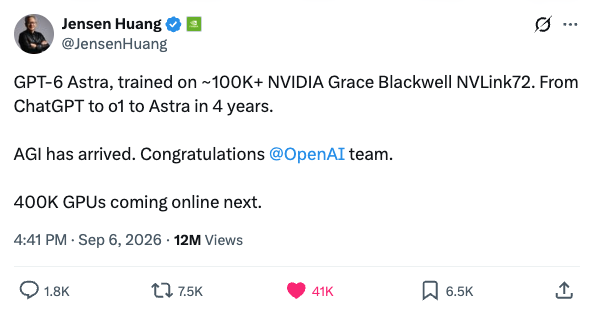
In a way, I feel like that the 2020s are The Short Decade: the way that the 20th century was 1 , between 1914 and 1991, for Eric Hobsbawm.2
Who was Hobsbawm?
He is best known for four books that, together, tell the story of the modern world. The first three cover what he called the long nineteenth century: "The Age of Revolution: Europe 1789-1848", "The Age of Capital: 1848-1875", and "The Age of Empire: 1875-1914", from the French Revolution in 1789 to the First World War in 1914. The fourth, "The Age of Extremes: The Short Twentieth Century 1914-1991", published in 1994, covers the twentieth century.
Why long, and why short? Because Hobsbawm didn't count centuries with the calendar. He counted them with events: a century starts when its world starts, and ends when that world ends. The world of revolutions, factories, and empires began in 1789 and lasted until 1914: a long century, of 125 years. The twentieth century began with the First World War, in 1914, and ended with the collapse of the Soviet Union, in 1991: a short century, of only 77 years.
And what a 77 years. Hobsbawm split them into three parts: an Age of Catastrophe, from 1914 to 1945, with two world wars, the Great Depression, and fascism; a Golden Age, from 1945 to 1973, of growth and social change the world had never seen before; and the Landslide, from 1973 to 1991, when that order came apart. In the first year of his century, soldiers still rode into battle on horseback. In its last year, 1991, the World Wide Web opened to the public. A short century, so dense, so packed that it felt like several.
He also wrote it as someone who had lived through almost all of it: he was born three years into the century he was describing. In the preface, he says that no one can write about their own lifetime the way they would write about a period they only know from the outside.3
The Short Decade (the 2020s) is still far from over, but it feels like my duty to start putting this write-up together at the beginning of its second half- as Hobsbawm started to write The Age of Extremes before the century was over.
This is an unprecedented, thrilling, and exciting time for humankind. As William Gibson said, the future is already here- it's just not evenly distributed. The way that in NYC folks already had skyscrapers in the 1930s, yet it took a few other decades to get to other parts of the world-4 it feels the same way with intelligence, it's already in the hands of a few million believers and enthusiasts, but still to get to the hands of billions of humans to benefit from it.
The Short Decade, in step changes
To me, and I'm sure to most of us as well, AI felt really like an "overnight success". I started using ChatGPT around January 2023, and since, almost every single release from the lab felt like a great leap forward.
Here are some step changes from this Decade so far:
- January 2022, InstructGPT: models that follow instructions, thanks to .
- November 2022, ChatGPT: chat- what changed the world forever.
- March 2023, GPT-4: intelligence that was actually useful.
- September 2024, o1: .
- February 2025, Claude Code, and then Codex: coding agents.
- November 2025, Claude Opus 4.5: agents that actually work- engineers are the ones that felt this the most. Before this release, engineers felt like they had to "babysit" their coding agents- in the industry, since this release, we felt a step change: we could trust a coding agent to finish an entire set of features, independently.
- April 2026, GPT-5.5: another leap in model capabilities. From here, as a developer, I could trust a coding agent to debug and to QA itself, without my supervision, whatsoever.
- June 2026, Claude Fable 5, and in September, GPT-6 Astra: another leap. Jensen Huang called Astra the first version of AGI.
- August 2026, Grok Bot: personal agents.
- September 2026, Jev: System One models, typed decisions instead of text.
Ten (if not more) eras in under five years. Hobsbawm's short century had three, in 77.
In this primer, I want to provide a map of where we got to so far in the world of AI Engineering. I want to start a quick overview on: how we started, prompt engineering. How we then quickly moved onto Context Engineering. And then, how most recently we got to Loop and Graph engineering, and the latest darling of the AI space: Harness Engineering. And, at last, where all of it is landing: "personal" agents.
The point I'm trying to make with markdown engineering is that we had a lot of evolutions in AI engineering5 but ultimately they just were evolutions in how to manipulate a series of markdown files.
Prompt engineering was editing the system prompt and user prompt. Context engineering was about editing skills or CLAUDE.md or AGENTS.md. Loop engineering was to edit these files continuously (see the Hermes Agent and the Nous Research loop). Graph engineering is in a similar vein, but where an end-state is clear and pre-defined. To an extent, all of these things are literally essentially editing .md files, which might have different names like CLAUDE.md, AGENTS.md, memory.md, SKILL.md, or something.md. Essentially, though, all of this is still markdown engineering.6
I am not saying this with the intent to be reductive of this progress (from prompt to harness engineering), but rather to express how fascinating it is that: even with intelligence improving, we can squeeze even more intelligence from these models, with "just" having the right markdown files in order.
We might have gotten used to this because all of the progress happened really fast, but still, we already live in a new world, just most don't know it yet.
part 02.human / machine
Prompt Engineering
Before the chat
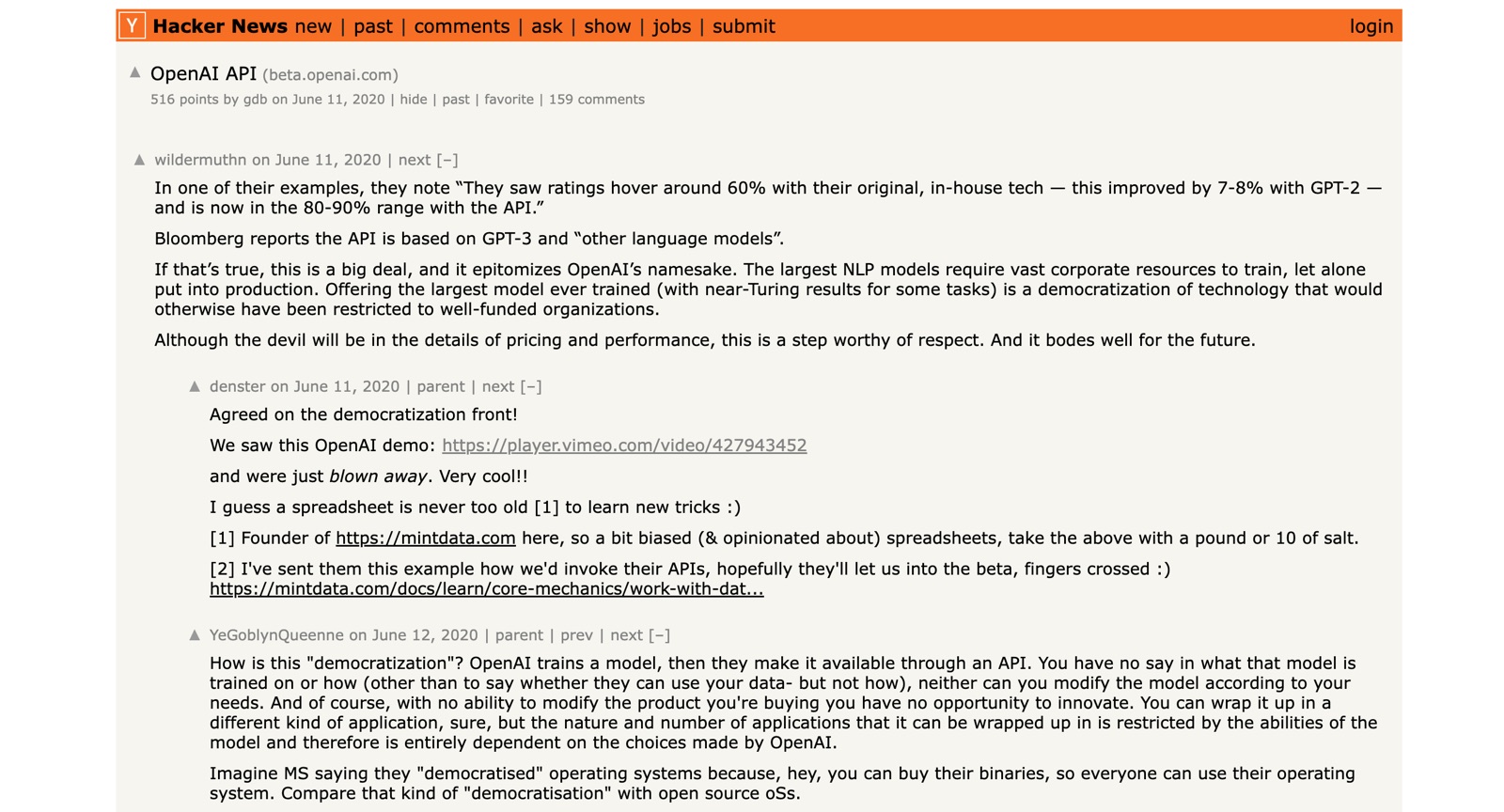
Prompt engineering actually started before ChatGPT. In June 2020, OpenAI opened up the GPT-3 API. There was no chat yet: you gave the model the beginning of a text, and it continued it. So if you wanted an answer, you wrote the start of a document where that answer would naturally come next: a question, then "A:", like you had to give a few examples and then leave an empty space which is where its answer would start. The GPT-3 paper put it right in its title: Language Models are Few-Shot Learners. Show the model a few examples inside the prompt, and it picks up the task- no retraining needed.
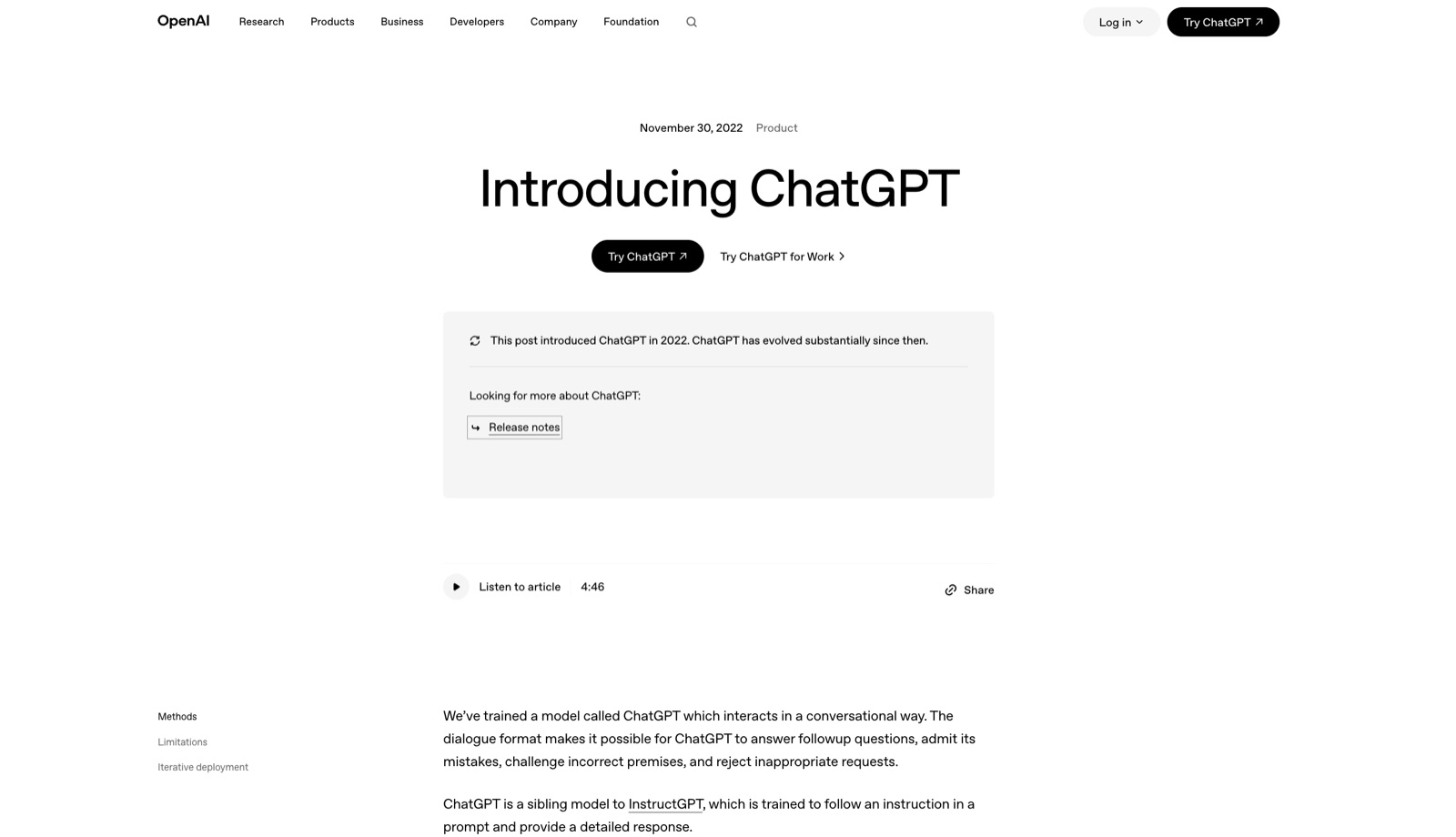
Then, in January 2022, OpenAI made its InstructGPT models the default in the API: models trained with human feedback () to follow instructions, instead of just continuing text. And by the end of the same year, on November 28th 2022, we got it, we got: ChatGPT.
And that's when the world, changed.
Two levers
When engineers first got access to the OpenAI chat API, in March 2023, there first was 2 levers: and . Yes, another was . But we quickly learned that System and User Prompt engineering is where most of the sauce would be.
Here, the industry gave us different types of prompting techniques:
- : just ask. "Which language is this text in?"
- and : show one example of what you want, or a few. (Brown et al., 2020)
- Roles: "You are a meticulous copy editor."
- : spell out what a good answer looks like, so that you, and the model, can check it.
- Markdown and XML tags: give the prompt a structure, so the model knows where the instructions end and the data begins.
- : show the model the steps, not just the answer. Wei et al. (2022) found that this improved performance on arithmetic, commonsense, and symbolic reasoning- just this alone was a capability jump.
- : ask several times, and go with the most common answer. (Wang et al., 2022)
- : explore a few possible next steps, judge them, and backtrack when a path looks wrong. (Yao et al., 2023)
- : reason, act (search something, call a tool), look at the result, and repeat. (Yao et al., 2022) Keep this one in mind: it opens the door to everything that comes next.
and temperature?
Temperature, top-k, top-p, and beam search are all ways to pick the next word (token) from the model's predictions. Temperature makes the pick more or less random. Top-k only picks from the k most likely tokens. Top-p, or (Holtzman et al., 2019), picks from the smallest group of tokens that adds up to a given probability. Beam search keeps several candidate sentences going at once, and returns the most likely one overall. They are dials on how the model chooses its words; none of them gives it new information.
YesMaybeNoUnknownOtherIllustrative logits: 2.5, 1.7, 0.8, 0.2, -0.7. Outlines show the full distribution; fills show the distribution after top-p selection and renormalization.
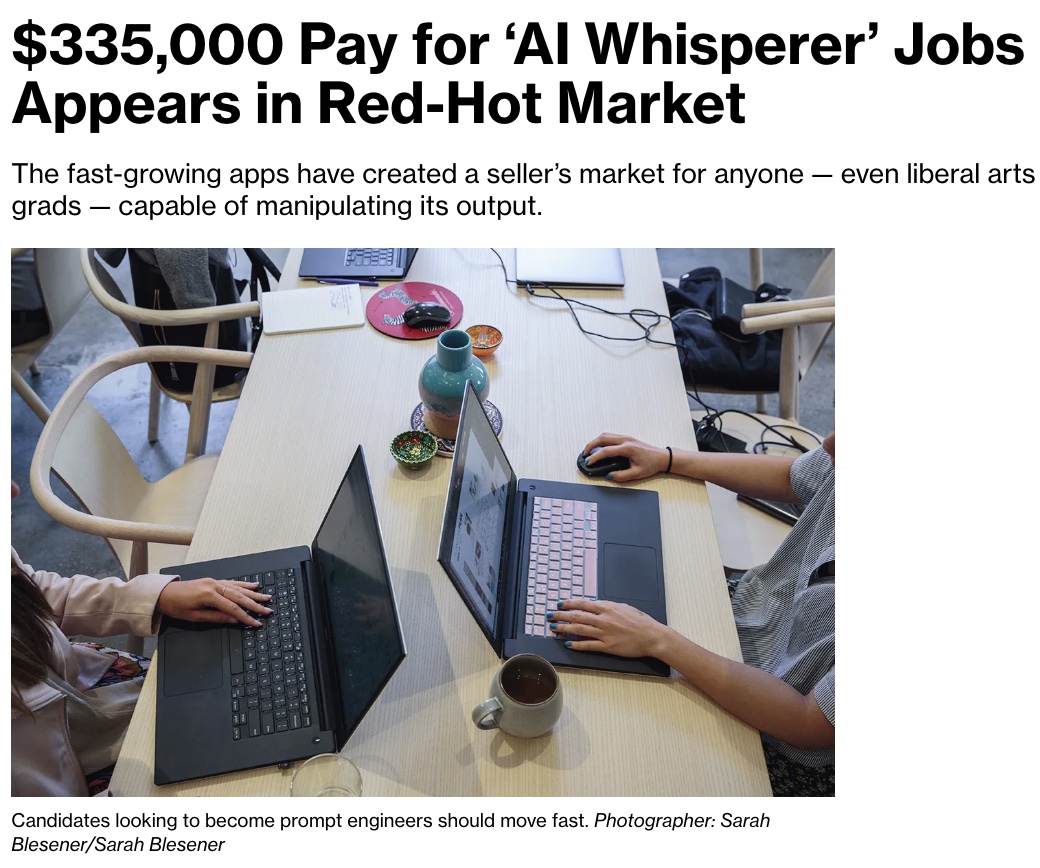
So much so, that entire job postings went viral in this time. Do we all remember, when prompt engineers were offered to be paid plenty of sweet $$$ dollars? Anthropic, for one, advertised a Prompt Engineer and Librarian role at $175,000 to $335,000 a year.
Structured outputs
When this technology came out, people quickly understood that the value of LLMs could be leveraged for literally (putting a piece of text into one of a few categories: spam or not spam, positive or negative, which language it's written in). What previously had to revert to traditional data science methods that struggle to generalize, now could be easily prompted. However, outputting a specific class, initially, was harder than anticipated.
Take language classification for example. Let's say we need to classify in which language this sentence is "Io adoro mangiare la pizza". Let's say that our code expects one of the categories we defined: English, Italian, Portuguese, and so on. The model might correctly identify the language, but return "italian", "ITA", "ita", or "IT", instead of "Italian". It might even return "Italy".
Technically, directionally, they are all correct. But, if the code we have later has a specific tag, the code would just break. Here is how the developer community hacked its way around this issue, and how that subsequently led to changes in the OAI itself.
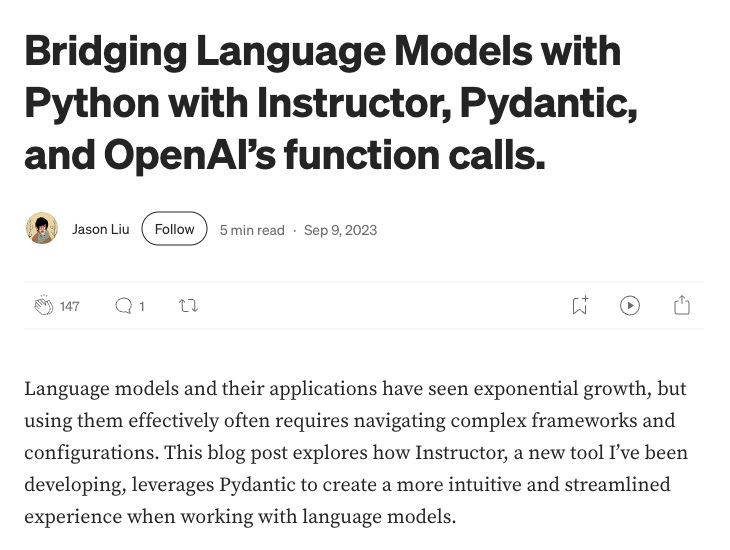
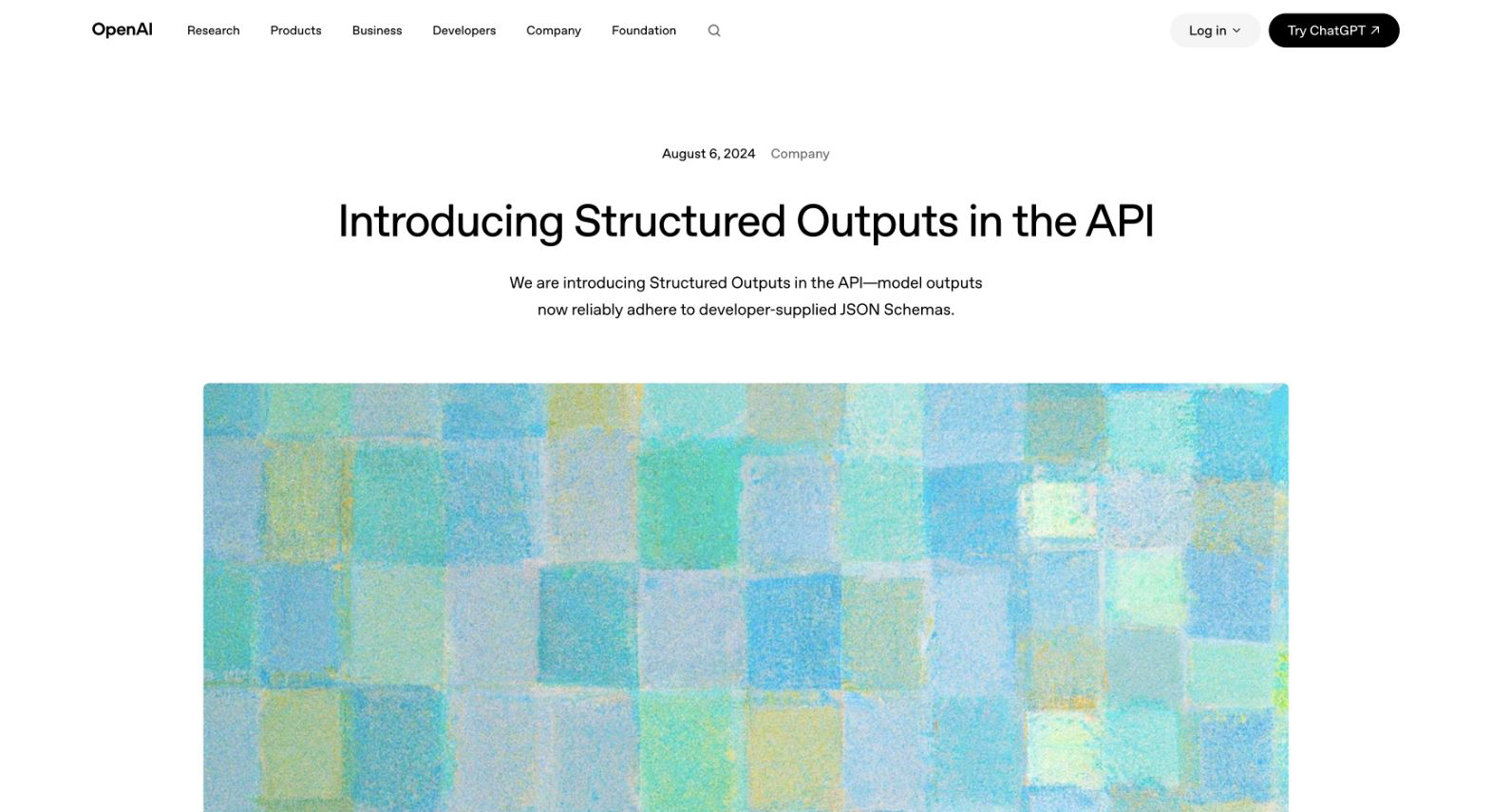
In June 2023, OpenAI introduced function calling: developers could describe the fields they expected with a schema. That same year, Jason Liu built Instructor on top of it with Pydantic: you define your fields and your allowed categories in Python and then Instructor checks what comes back, and asks the model again when it doesn't match. In November 2023, OpenAI added JSON mode. But even if {"language": "italian"} is perfectly valid JSON- we still had to check the values of the classes ourselves. Then, on August 6th 2024, OpenAI shipped Structured Outputs: the model's answer could now be held to the exact schema, allowed classes values included- in the announcement, OpenAI credited Instructor and other open-source libraries as inspiration! Again, look at the speed (!!!): from community hack to a native feature of the API in about fourteen months.
And then, something shifted
But then: function calling turned out to be about much more than formatting. If the model can fill in a schema, it can also ask the application to do something: search, run code, call an API. And with Claude 3.5 Sonnet, in June 2024, models started using tools well enough that it felt like working with an agent. This is where prompt engineering started turning into context engineering: what the model sees is no longer only what we write, but also what its can bring back.
Only five months later, on November 25th 2024, as tools started to become really popular: Anthropic open-sourced , the Model Context Protocol, a standard way to connect a model to tools and data. A tool written once could now work in any app that speaks MCP (more on it below, in MCP).
And just like that, Claude Code was born on February 24th 2025: the first harness was born.
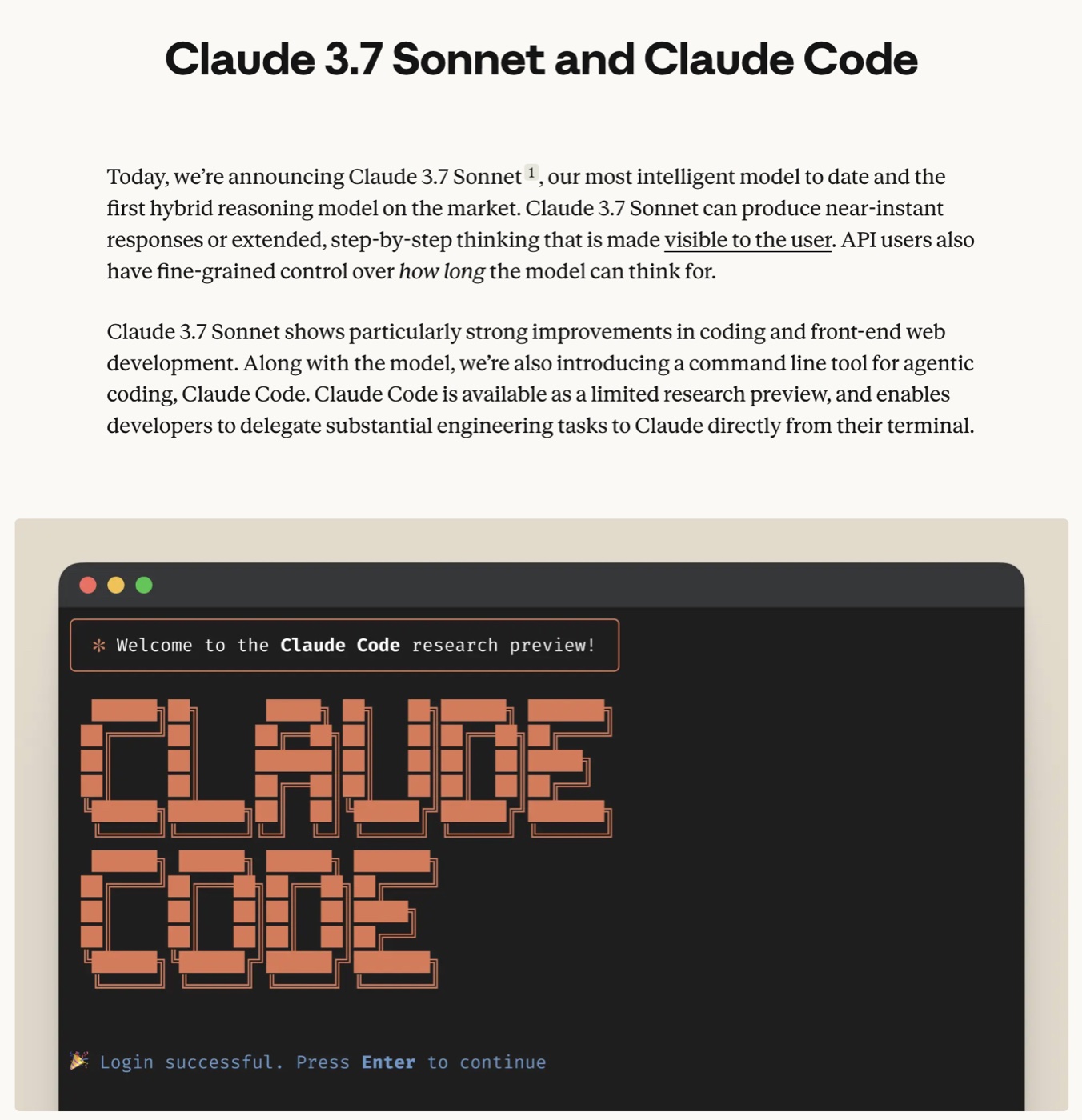
Later, Codex CLI followed on April 16th 2025- fun fact many don't know: open source from day one.
Something here shifted. From here, agents were able to navigate directories, do actions in a terminal. This is the moment that we go from just an API that replies after being prompted, to an actual "agent" inside your terminal able to take actions.
Technically, the model still only writes text. But some of that text is a : a structured request to read a file, edit it, or run a command. The program around the model checks whether a specific tool is allowed, then it "calls" the tool, and sends the result back that it got from the tool call. The "magic" essentially is now how the model can read the result of the tool call, decides what to do next, and the cycle repeats until the work is done.
From here, we enter:
part 03.a frame of reference
Context Engineering
From context engineering, we understand that it is no longer about passing the right System or User prompt, but rather, holistically: the right context.
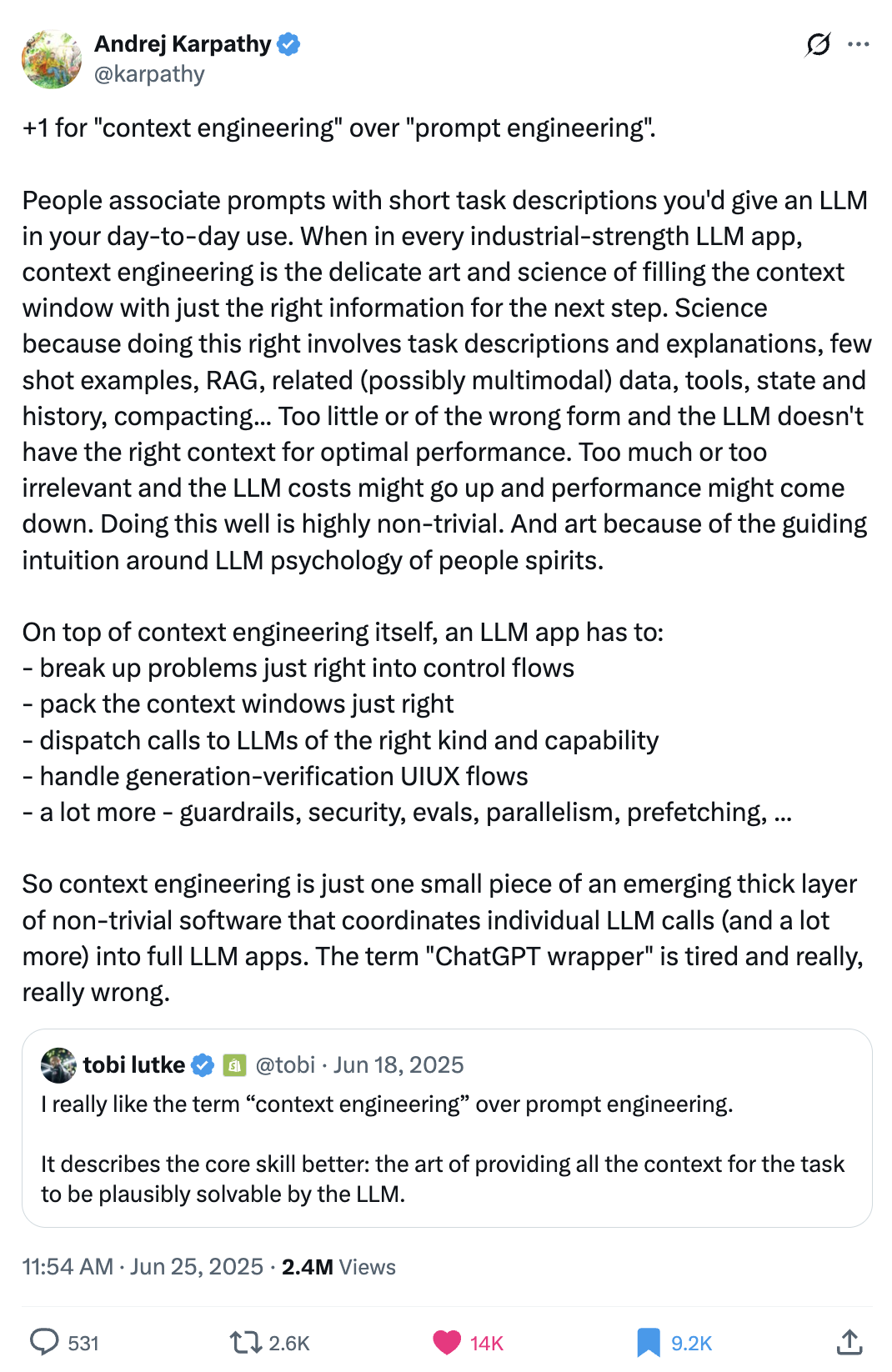
Andrej Karpathy made the name stick on June 25th 2025:
How do we make sure that context is passed onto the model? Well, it can be passed inside the prompt (be it the system or user prompt), for example:
Summarize the decisions in these meeting notes.

<context>
{meeting_notes}
</context>
But, how do we pass the right context?
RAG
So, do we dump an entire db, or PDF, or book inside an LLM's context window?
Not necessarily. Because of and performance considerations, it is often better to retrieve only the relevant information. This is where , retrieval-augmented generation, comes in. The term comes from a 2020 paper by Lewis et al., Retrieval-Augmented Generation for Knowledge-Intensive NLP Tasks. The original research architecture and what later became the famous industry implementations, though, are not exactly the same thing.
Taking a step back, the general idea is that before the model answers, a search for relevant information takes place, and the retrieved content is added to the model's input instead of dumping potentially irrelevant information into its context.
Now, there are a lot of ways to do retrieval, but one of the most popular approaches became storing document embeddings in a vector database, comparing the query embedding against the stored embeddings using a similarity measure (such as cosine similarity, broadly, think of semantic search), and passing the most relevant document chunks into the model's context.
The original paper actually used dense vector search too, but its architecture was more sophisticated: the researchers jointly fine-tuned the query encoder and language generator, while keeping the document encoder and its precomputed embeddings fixed. They also combined predictions across multiple retrieved passages, rather than simply retrieving chunks and feeding them to an off-the-shelf LLM.7
Nonetheless, 2023 was, in a way, the year of RAG: embeddings, vector databases, and "chat with your PDF" (IYKYK: chatpdf.com) demos everywhere.8
But context engineering is not the same thing as RAG. It is much broader than just retrieving the right information. RAG is one approach to augmenting generation with retrieved information; context engineering is the discipline governing what an LLM receives at inference time: the instructions, the conversation so far, the tools it can use and what they return, the documents it retrieved, and its memory.
In a way, context engineering is more an art than a science. More than a specific research architecture, it is a broader practice that becomes particularly relevant in business settings. The reason it's hard is that context engineering isn't just about passing the right information to the model, but determining what information is actually relevant in the first place.
And what does "relevant" even mean in a business setting, within a specific company?9
The context window is a budget
Let's say though that we found all the relevant things to show to an agent- unfortunately, we might still not the able to give it everything. Everything the model sees has to fit in its , and that window is finite. The context window is how much text a model can hold at once, counted in tokens: the instructions, the conversation so far, the context you are adding, the tools and what they return, and the answer it's writing. GPT-1 could hold 512 tokens. GPT-2, 1,024. GPT-3, 2,048. Then the window went from 8,192 tokens with GPT-4, in March 2023, to 1 million with Gemini 1.5, less than a year later.
To make this tangible: we went from room for roughly 16 pages of text with GPT-4 to around 2,000 pages with Gemini 1.5, less than a year later. That assumes about 500 tokens per page. From a short document to several books, inside a single context window.
the context window, since 2018
However big the window gets, it has a limit, and the longer an agent works/thinks, the more quickly it fills up- how it works is that everything it thinks through, does, everything is literally written in the context window; every file it opens and every command it runs stays in the window, when there's no room left: the work literally stops.
The main new trick here is , which is a fancy way to say "summarization": when the history gets too long, the agent summarizes it, and keeps going from the summary.
The window stays the same size, but the agent gets its "room back" because it's now running off of a "tldr". There is of course a tradeoff though: whatever the summary doesn't include, suddenly, the agent no longer knows it, but rather, "forgets it". This matters because: even if agents are capable of running larger and more complex tasks, they can still be limited if length of such a task no longer has to fit inside the context window.
Claude Code had a /compact command by the time it launched in February 2025, and by March it did this on its own: "Automatic conversation compaction for infinite conversation length". In February 2026, with Opus 4.6, compaction came to the API.
And then there's caching. If the beginning of every request is the same (same instructions, same tools), the provider can reuse the work it already did on it. has been around since the GPT-2 days; in 2024, it became a product feature: context caching at Google, prompt caching at Anthropic and OpenAI. Think of caching as a fancy way to say "re-using" parts of your user prompt, if the content of the prompt is the same. This leads to cheaper and faster requests, as long as the same part of your context/prompt is at the front- see below.
Infinite context windows?
go one step further: instead of stuffing a huge document into the context window, the model gets to explore it piece by piece, calling itself on the parts that matter. Put simply, an RLM keeps the text outside its window and calls itself on one piece at a time, so nothing has to fit all at once, and that is why RLMs give the illusion of an infinite context window. See my notes on RLMs for a breakdown.
Compaction makes the history smaller so it fits- whereas an RLM leaves the text outside the window, and lets the model reach for it. Alex Zhang and Omar Khattab, from MIT, wrote about the idea on October 15th 2025, and the paper (Zhang, Kraska, and Khattab) came out on December 31st 2025.
Anthropic cited the paper on April 8th 2026, in Scaling Managed Agents with stable interfaces. The toughest research issue with compaction is that compaction can't be undone, and it might leave out necessary pieces: "it is difficult to know which tokens the future turns will need." This is where they cited RLMs: "Prior work has explored ways to address this by storing context as an object that lives outside the context window." . It is unclear whether ANT uses RLMs within their products or the concept of Recursive Compaction10 - nonetheless, this is another example of speed of progress from the community, or academia, into the big labs.
Agents like folders
All of this- somehow, also relates to the concept of directories. What is a directory? Directory is a fancy way to say folder. A path, is essentially how many folders and which ones you need to click to get to the file or the folder you want. In ai-minutes/articles/the-short-decade.md, you open ai-minutes, then articles, and there it is: the-short-decade.md.
The concept of directories, so far, has been mainly used by a repository. A repository, a repo, is a project folder with its whole history saved (that's what Git does). GitHub is where most people store their repos, for coding.
Turns out, coding agents really like organized file directories, and repos. This is why they can literally just do anything related to coding.
CLAUDE.md
Claude Code was born on February 24th 2025. In that time, in the months after that, we have learned the importance of the context we provide the agent: the CLAUDE.md file. And not only 1 md file, but one per directory level (meaning, per folder).
A CLAUDE.md (or AGENTS.md, for Codex and others) is a of instructions for the agent: how to run the tests, which conventions matter, which mistakes to avoid. The one at the root of the project applies everywhere, the ones deeper in the folders apply to the content and code files of the folder they are in.
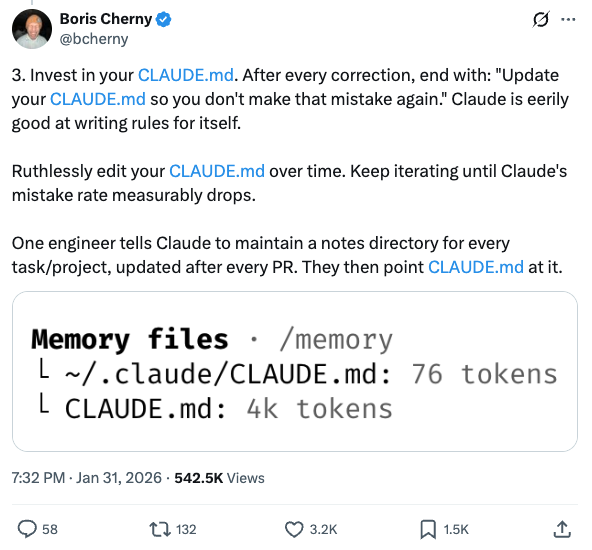
Most importantly though, as your codebase changes, your work evolves, it also means that the context to work on it evolves: the way you would onboard a new team member today to your codebase is not the same as you would onboard a new team member 6 months ago- that codebase has changed in the past 6 months.
This means that context is not, and cannot and should not be static. This is so much so important that Boris Cherny on Jan 31st 2026 started talking about the importance to keep your CLAUDE.md (your context) up to date:
SKILL.md
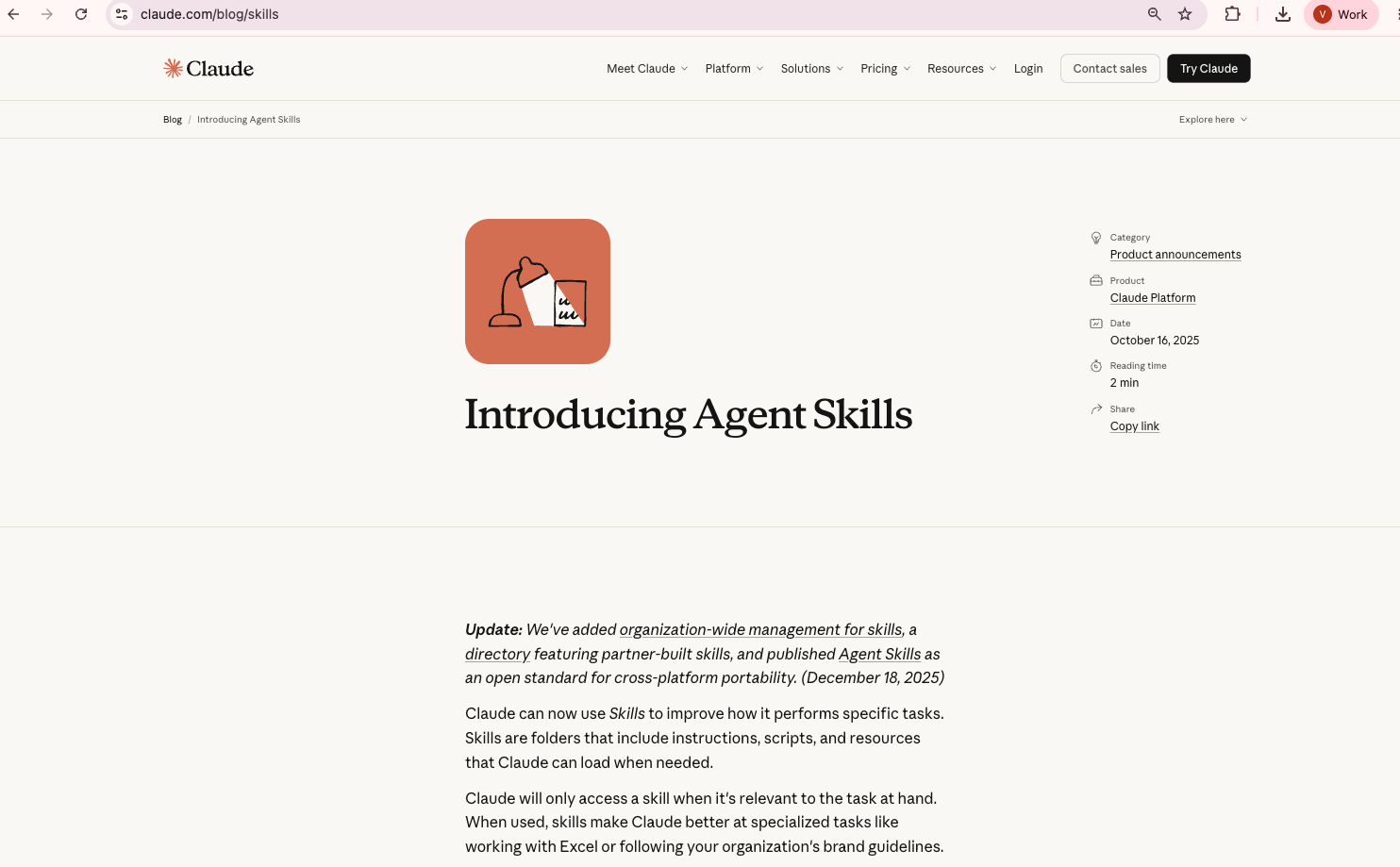
In the meantime, in October 16th 2025, another "context" md file was born: the SKILL.md file.
is a folder with a SKILL.md inside: a name, a one-line description, and then the instructions for doing one specific kind of task- plus scripts or templates, if needed. The main difference is: your CLAUDE.md says how we work here/how work gets one/the rules an agent should follow overall; whereas a skill says how to do one particular thing (for instance: something that you do many times, the same way).
From coding to knowledge work
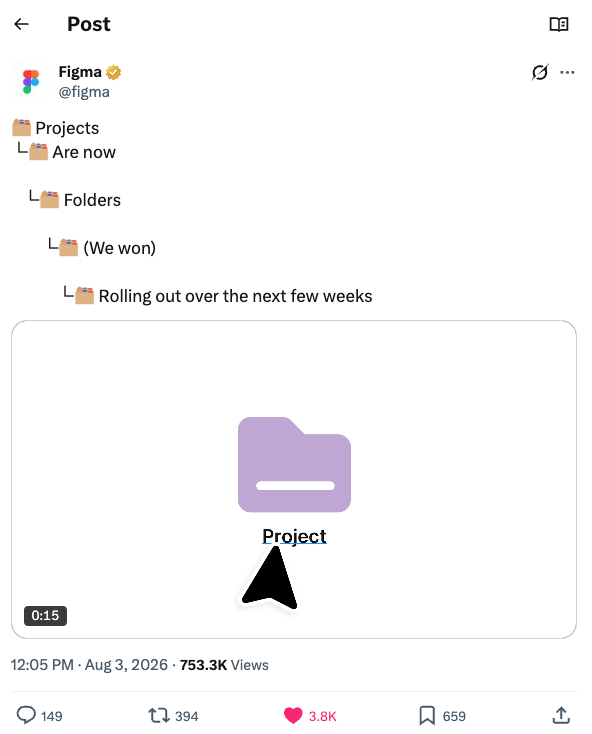
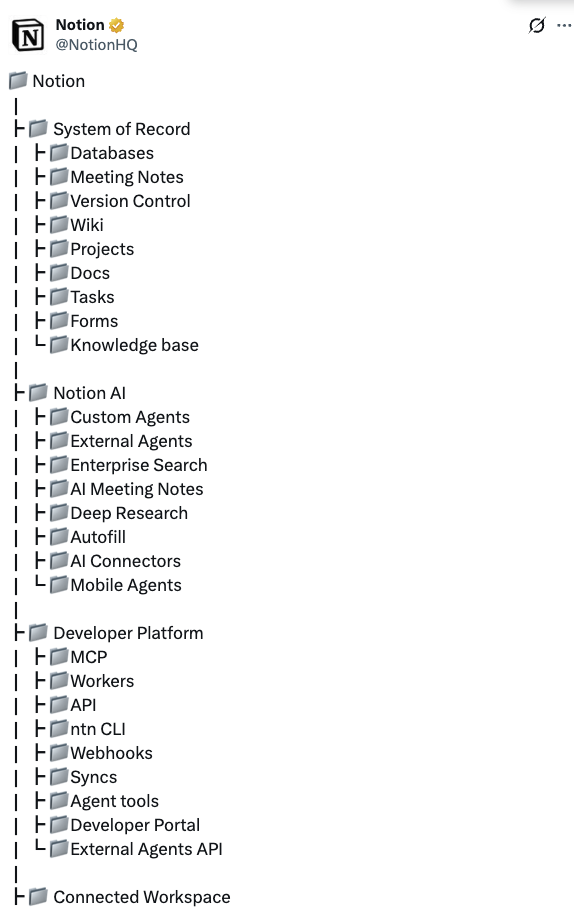
But- coding is not the only thing that humans want agents to do. We care about agents to do useful things for us, for our knowledge work, not only for coding. For instance, Companies like Figma and Notion are taking the concept of directories (GitHub) and pushing it further to be generalized for knowledge work.
Yet, all of these learnings did indeed come from: coding, and AI engineering.
And from here, we get to: how do we keep our Context up to date?
Me and you, have so far agreed on the fact that: Context is not static, it changes, it evolves, it grows with us. With our codebase, for coders, and with our knowledge, for knowledge workers.
So how do we change it? Manually? We can, but what about a self-healing feedback loop?
Context evolves. I can see a friend four times over the year. Every time we meet, I say "let me give you some context,"- context is not static, it is dynamic. It should evolve over time. And in software, that update should not be manual. Most importantly, context is only as good as the feedback loop that feeds back into it and updates it: everything is a feedback loop.
I wrote that in Everything should be a closed feedback loop. A loop, by the way, is literally not rocket science- it simply is: act/take an action, look at what happened, compare it to the goal (important: you need to have one, i.e. a ""), and based on the evaluation compared to that ground truth (the "") then let that change and inform what you do next and how.
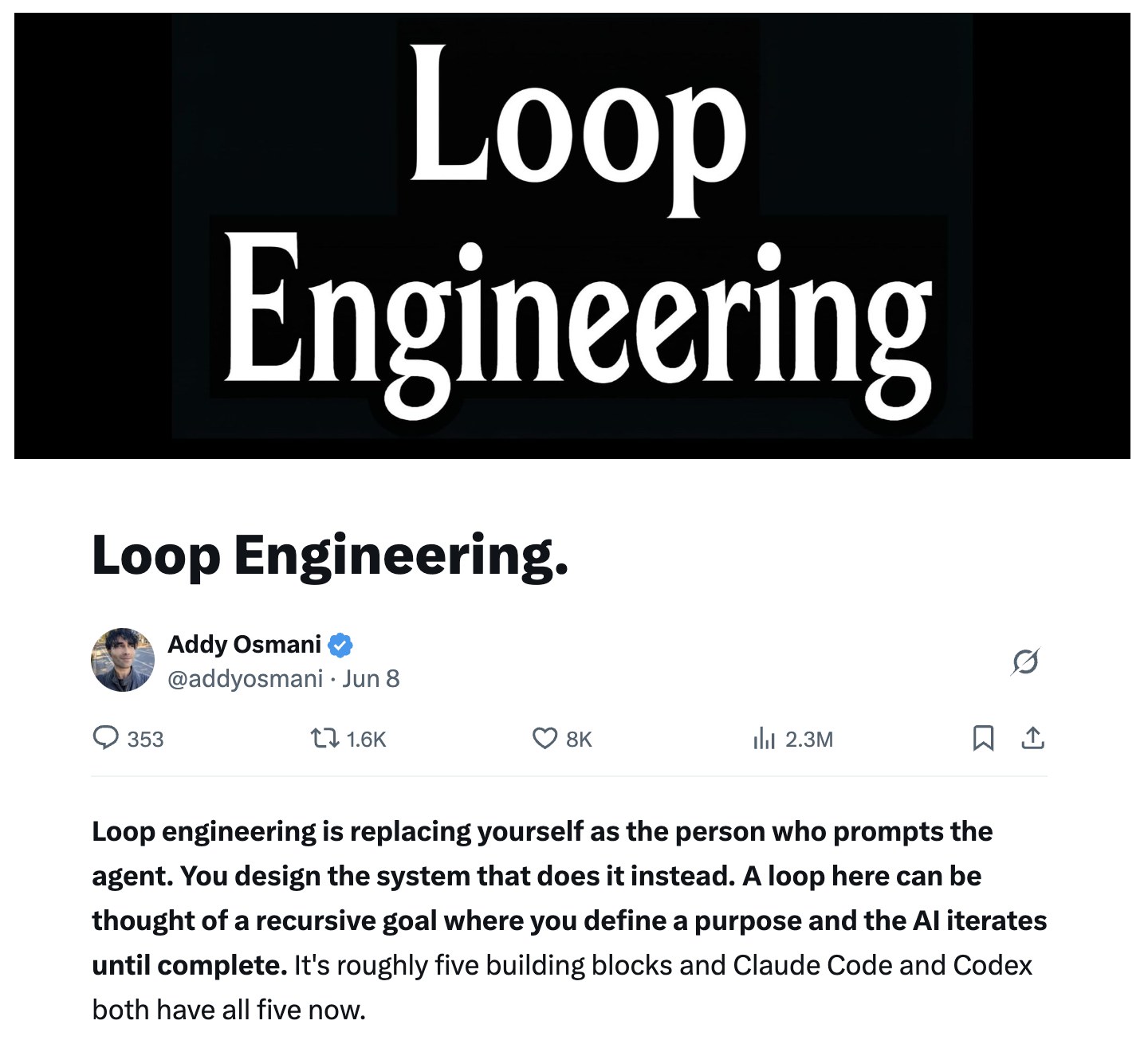
A note on the name: "Loop engineering" took over X in the summer of 2026, but it wasn't really a new thing. What happened underneath was slower, and bigger: reasoning models, starting with o1 in September 2024, and agents that could keep working on their own for longer and longer, like Claude Opus 4.5 in November 2025.
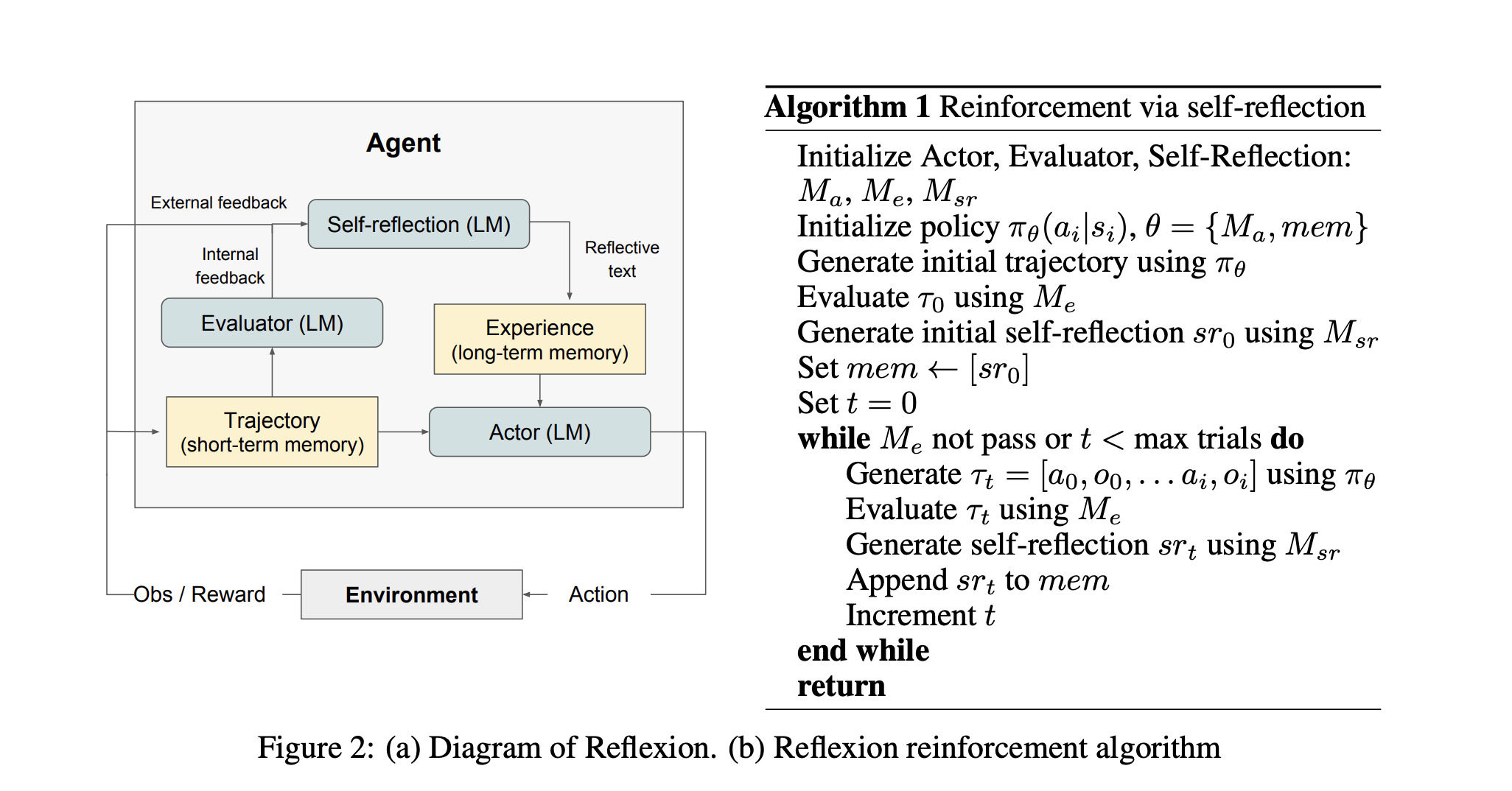
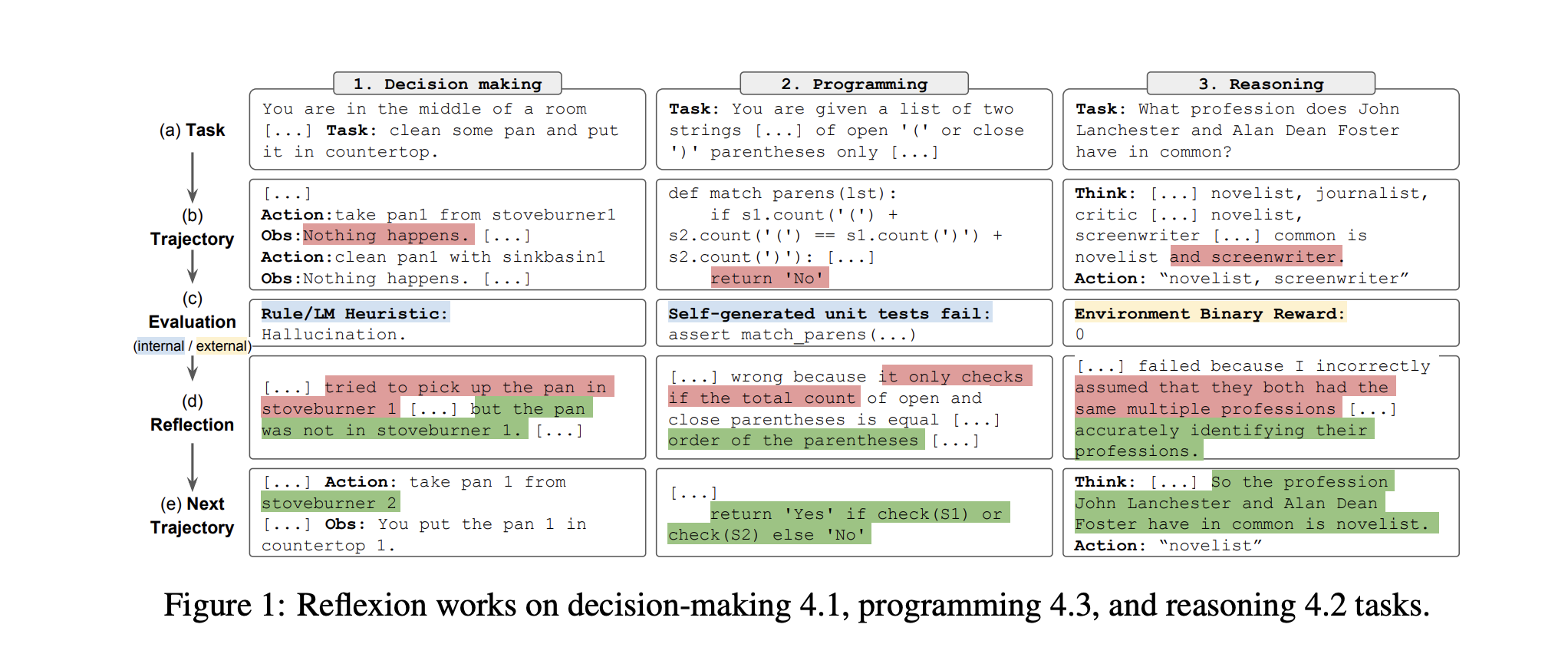
And, as usual, researchers got there long before the hype. In 2021, the Scratchpad paper (Nye et al.) showed that letting a model write out its intermediate steps before the final answer helped it with things like long addition and tracing what a program does. In 2022, Language Model Cascades (Dohan et al.) gave this a name. A cascade is what you get when you stop calling a model once: one call writes out its reasoning, another checks it, a tool looks something up, and each result feeds the next call. The paper's point was that scratchpads, verifiers, tools, and models calling models are all the same thing: a composition of model calls, which you can write down as one program- it's essentially the idea underneath every agent, four months before the release of ChatGPT. In 2023, (write, critique, revise) and (write down the lesson from a failure, and hand it to the next attempt) made the loop a method, long before "loop engineering" made it to X this summer, in 2026.
Reasoning
Reasoning means the model works through a problem step by step before it answers, instead of answering in one go. It belongs under the umbrella of loops because it's a loop inside the model: try something, check it, notice the mistake, go back.
Interestingly though, it actually started as a prompting trick. In January 2022, (Wei et al.) showed that when the examples in a prompt spell out the steps, the model writes out steps too, and gets more right. That March, STaR (Zelikman et al.) let a model learn from its own explanations. That May, Kojima et al. found you didn't even need examples: "Let's think step by step" was enough. In May 2023, Let's Verify Step by Step (Lightman et al.) trained a model to judge each step of a solution, not only the final answer.
Then, from prompting, reasoning moved into the model itself. On September 12th 2024, OpenAI released o1, trained to spend time thinking before it answers. On a qualifying exam for the International Mathematical Olympiad, GPT-4o solved 13% of the problems, and o1 solved 83%. Then, only a few months later, in January 2025, DeepSeek-R1 arrived with open weights, an MIT license, and a paper showing how it was trained, so reasoning stopped being one lab's secret- in just a few months.
Evals, evals, evals
Now, from an AI engineering perspective, it is crucial that loop engineering doesn't happen with just a for loop for the sake of it, i.e. flying blind. This is where evals come in. Evals help you make sure that what you are editing within a loop, is being edited towards the right direction, meaning that: you are avoiding , and that you are (hopefully) actually getting better.
The way Unit-tests stay to software engineering, evals stay to AI engineering. An is a test for an AI system: a set of tasks, and a way to score the answers, with a clear and correct ground truth dataset to check against. The way you can "debug" code with a Unit-test, the result of an eval tells you how to "debug" your ai system (meaning, how to edit, surprise surprise, another markdown file).
However, this adds another layer of complexity: you need a high quality ground truth- without it, your insights from your evals, are de-facto, useless. More on this on a previous writeup I did previously: read On Evals, with all of its visuals.
Hermes
And just like that, we get to February 25th 2026: Hermes agents from Nous Research are released to the world. And yes, they have that "magic thing": self-learning loop. That means, that they learn from interacting with you, the user, and re-write and update their own skills.
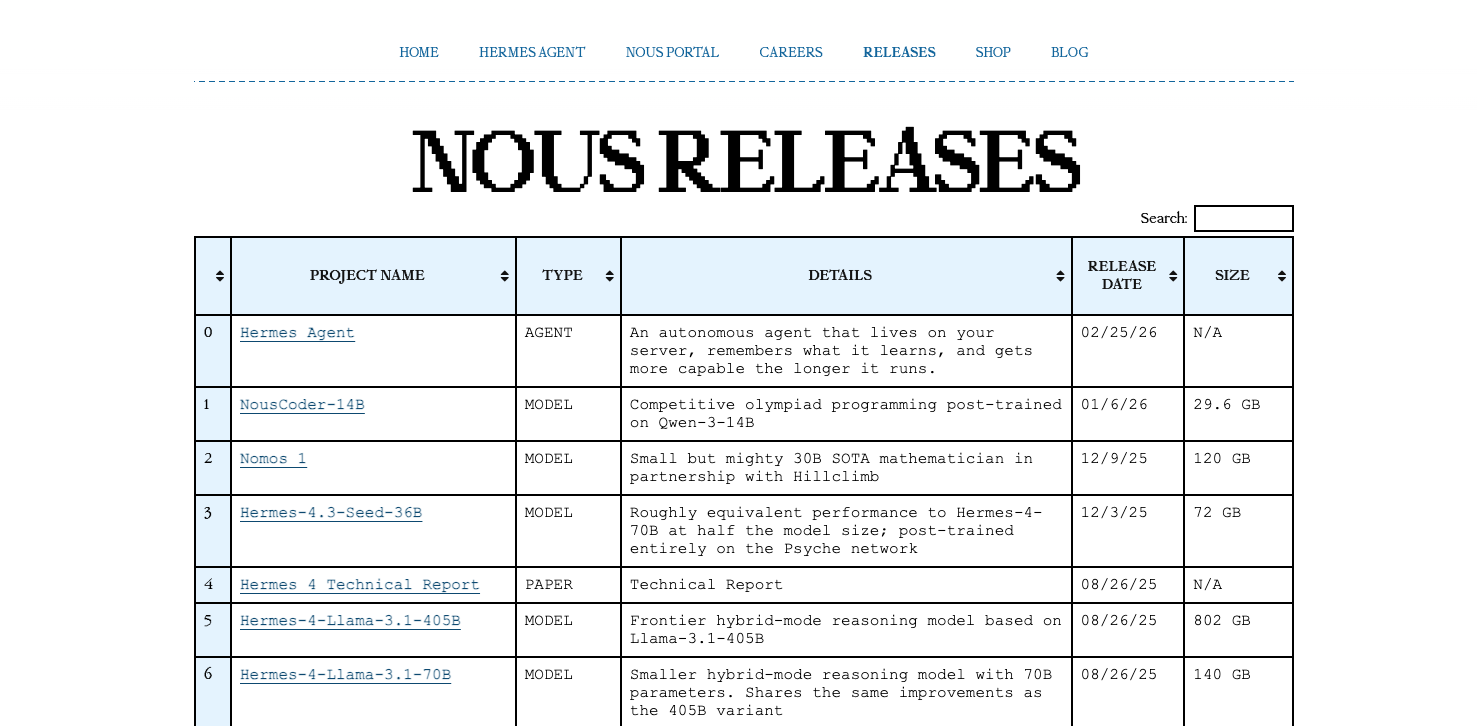
Remember: the model doesn't change, the weights stay the same. What changes is literally just a file- but the performance of your agent can drastically improve, literally by just editing a file. And the beautiful thing about this product interaction, is that you as a user are "labelling" data without actually doing it.
You are creating "ground truths" without any cognitive load to you- you are doing that just by interacting with the agent. This means that you can literally just correct Hermes as you interact with it once, and it can turn that correction into a new skill, or edit an old one, so the next conversation starts from the lesson instead of from zero. Remember Boris and CLAUDE.md? Same idea, but this time, automated and done for you (keep this in mind for when later in the article we get to personal agents- but tldr: this is where Muse and other personal agents took inspiration from, and why your user experience with those is so 'seamless' and 'magic').
Nous Research then went one step further with Hermes Agent Self-Evolution, a separate project that improves those skills automatically, using and .11
DSPy and GEPA
DSPy (Khattab et al., 2023) lets you write an LLM program as code, with inputs, outputs, and a score to optimize, instead of as one long string. GEPA (Agrawal et al., 2025) reads what happened when that program ran- which tools it called, what came back, where it went wrong- proposes a better version of the instructions, and keeps the versions that actually score better.
In Hermes, the first thing this optimizes is skill files. It tests the proposed changes, and any improvement still goes through a pull request, for a human to review.
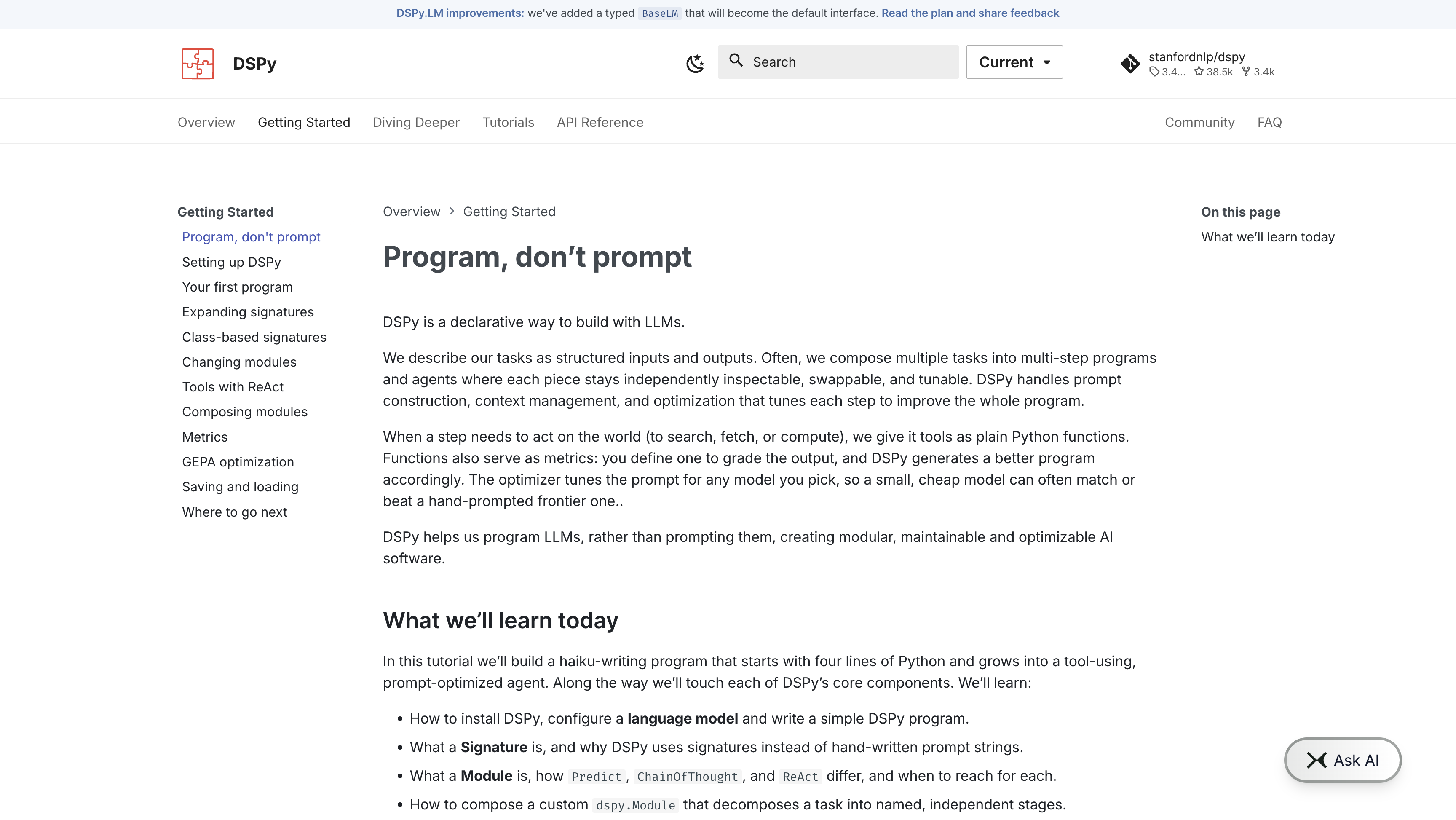
import dspy

answer = dspy.Predict("question, evidence -> answer, citation")

result = answer(
    question="When did the research preview launch?",
    evidence=release_notes,
)The way Unit-tests stay to software engineering, Evals stay to AI engineering.
part 04, continued.the connections matter
Graph Engineering
And graphs?
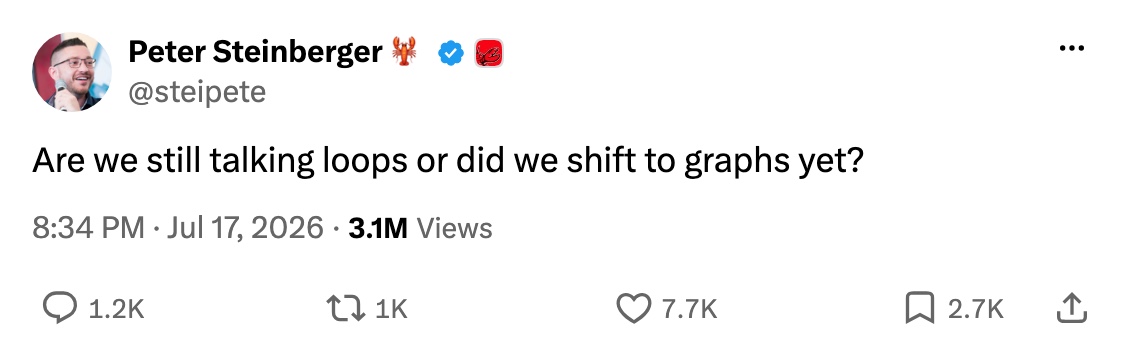
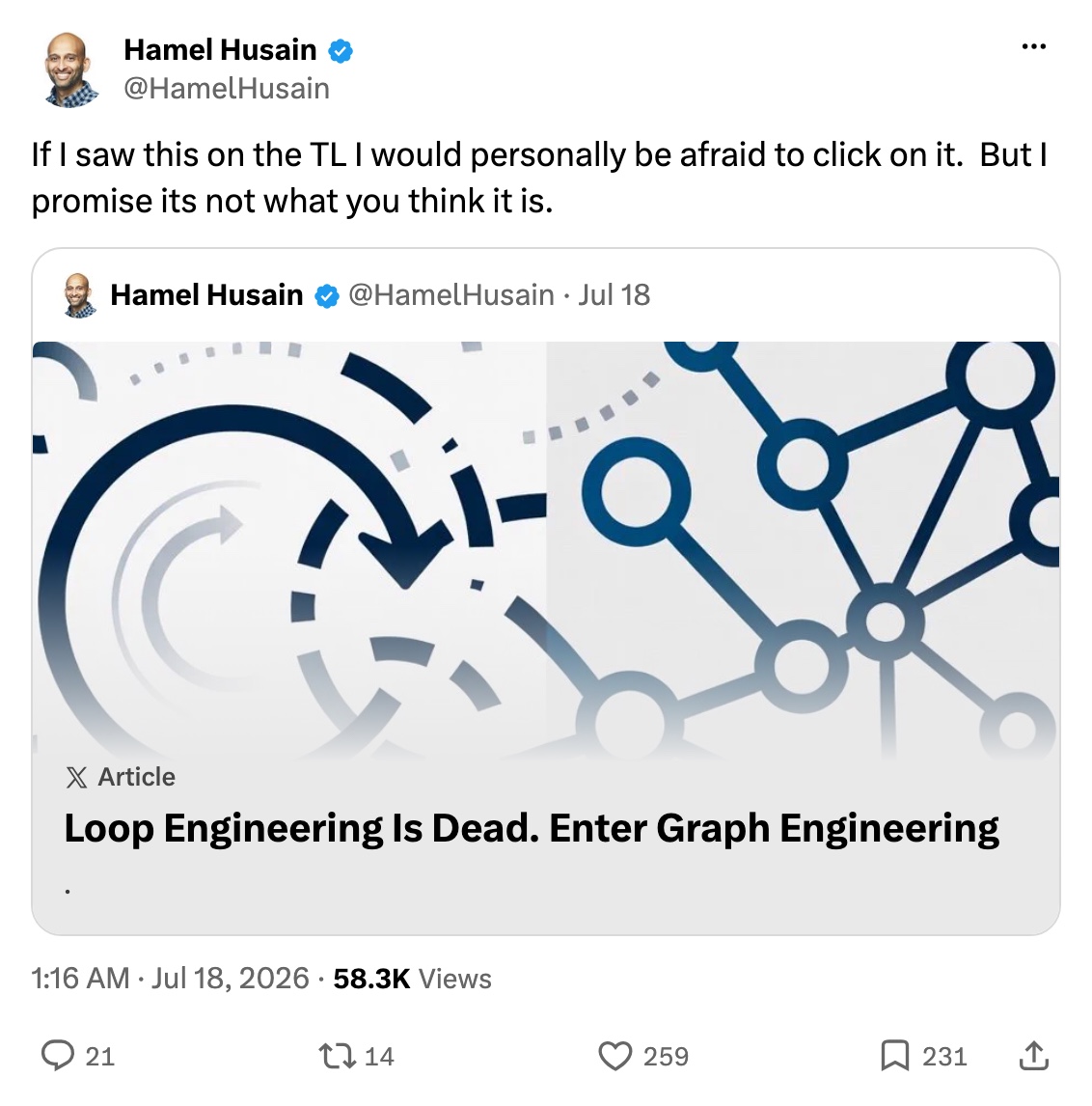
A few days after loop engineering, our X feeds went all on graph engineering. is a loop with the routes drawn out: think of a graph as pre-determined states. For instance: within a software product, there are only so many trajectories (meaning, clicks, actions, between different features, routes, and product surfaces) that are actually possible. There are only as many finite states you can end up on, like on a chess-board: that it is why it is called graph engineering- you can roughly approximate N nodes/states where you could end up. This sits to the opposite for pure /reasoning/knowledge work use cases, where the end-states are endless.12
Essentially: when you know the steps of a workflow in advance, a graph can make them explicit. When you don't, a loop can still let the agent figure out the next step as it goes. 13
And now to the latest evolution of markdown engineering (so far): Harness Engineering.
Claude Code was a big deal not because a new model was released, but because a harness was released.
When the Claude Code source leaked, on March 31st 2026, it was a big deal: this was the very first harness most of us were actually using, and now anyone could read how it worked. A paper followed, Dive into Claude Code, describing its core as "a simple while-loop that calls the model, runs tools, and repeats." Mal Shaik put it best: "an agent orchestration platform disguised as a terminal chat."
This made it pretty clear that we entered a new era: intelligence jumps are of course important, but the way you structure an environment, context, loops, and to an agent, is what actually makes it useful, powerful, and "alive".
So, what is a harness?
In simple terms: everything around the model that turns it into an agent. On its own, a model reads text and writes text. The harness is the code that:
- decides what the model sees (the context);
- gives it tools, and actually runs them: read a file, run a test, search the web;
- checks what it's allowed to do (permissions, a );
- runs the loop: call the model, run the tool, send back the result, repeat;
- decides when the work is done, or when to stop and ask a human;
- remembers things across sessions (memory, skills,
CLAUDE.md); - and, sometimes, wakes the agent up on a schedule: the heartbeat.
This is why the same model can feel so different in two different products.
A model is just one part of a much larger system. In a way, gasoline will perform differently if in a Toyota or in a Ferrari- where your model is the fuel, and the harness your car.
If this sounds a lot like context engineering with more code around it- honestly, it kind of is. You could call it the same era with a new name- I still like the name 'harness' though: it moves the attention from the model to the system around it, like as if the model was the gasoline, and the harness the car.
The harnesses out there
The harnesses out there today:14
- public: Claude Code (partially leaked), OAI, Clawdbot, Hermes Agent, Gemini CLI, OpenCode
- private ones: Notion does a few, Claude Design, ChatGPT agent, Manus, Cursor
For the private ones, we can only see what the product shows us.
MCP
A harness is only as useful as what it can reach. MCP, the Model Context Protocol, is how it reaches things: a common way to connect an agent to tools and data, like your files, your calendar, and your company's apps. Anthropic open-sourced it on November 25th 2024.
Before MCP, every new connection was its own custom job: each AI app needed its own connector for each tool. With MCP, a tool is written once, as a server, and any app that speaks MCP can use it. The docs compare it to a USB-C port for AI applications.
Think about it: if you have 5 different AI apps, and you want each of them to connect to the same 10 services, you could end up building 50 separate integrations. With MCP, each AI app implements the same standard, and each service exposes an MCP server that those apps can reuse. So, in the simplified framing, you go from 5 × 10 to 5 + 10: from 50 custom integrations to 15 implementations of a shared standard. That is what people mean when they say MCP turns an “M × N” problem into an “M + N” one.
Just a year since its release, there were more than 10,000 active public servers, and ChatGPT, Cursor, Gemini, and Microsoft Copilot had adopted it. Then, on December 9th 2025, Anthropic donated the Model Context Protocol to the Agentic AI Foundation, under the Linux Foundation.
From a business perspective, MCPs also have completely shifted and changed the software world upside down. Prior to the popularity of MCPs, users used to use software straight only from their UIs. Now, this lets agents use an UI, or even better, just call tools that appear on the UI. This is a huge shift, because users no longer have to waste time to learn a new complex/complicated UI if they no longer have to- they can just describe the objective of what they want to do, and achieve to an agent, and an agent can use any SAAS or any software tool as a tool.
In a way, MCP has suddenly turned software products into an app, that can be used by an agent (claude code, codex, oai chat, claude chat, etc.). This though, doesn't mean that agents are stealing business from software companies, to the opposite, they are adding to it.
For instance, if an agent gets Vercel as suggestion for a coding project, the user will have Vercel as part of their stack and they might not even know about it. This though doesn't matter to Vercel, because they are getting paid anyways. In this time, what I see, is that software companies that are less precious about how their users interact with their products, are the ones that are faster and better at creating top notch MCP user experiences for their users- and in a way, this drives more usage, and thence, more revenue.
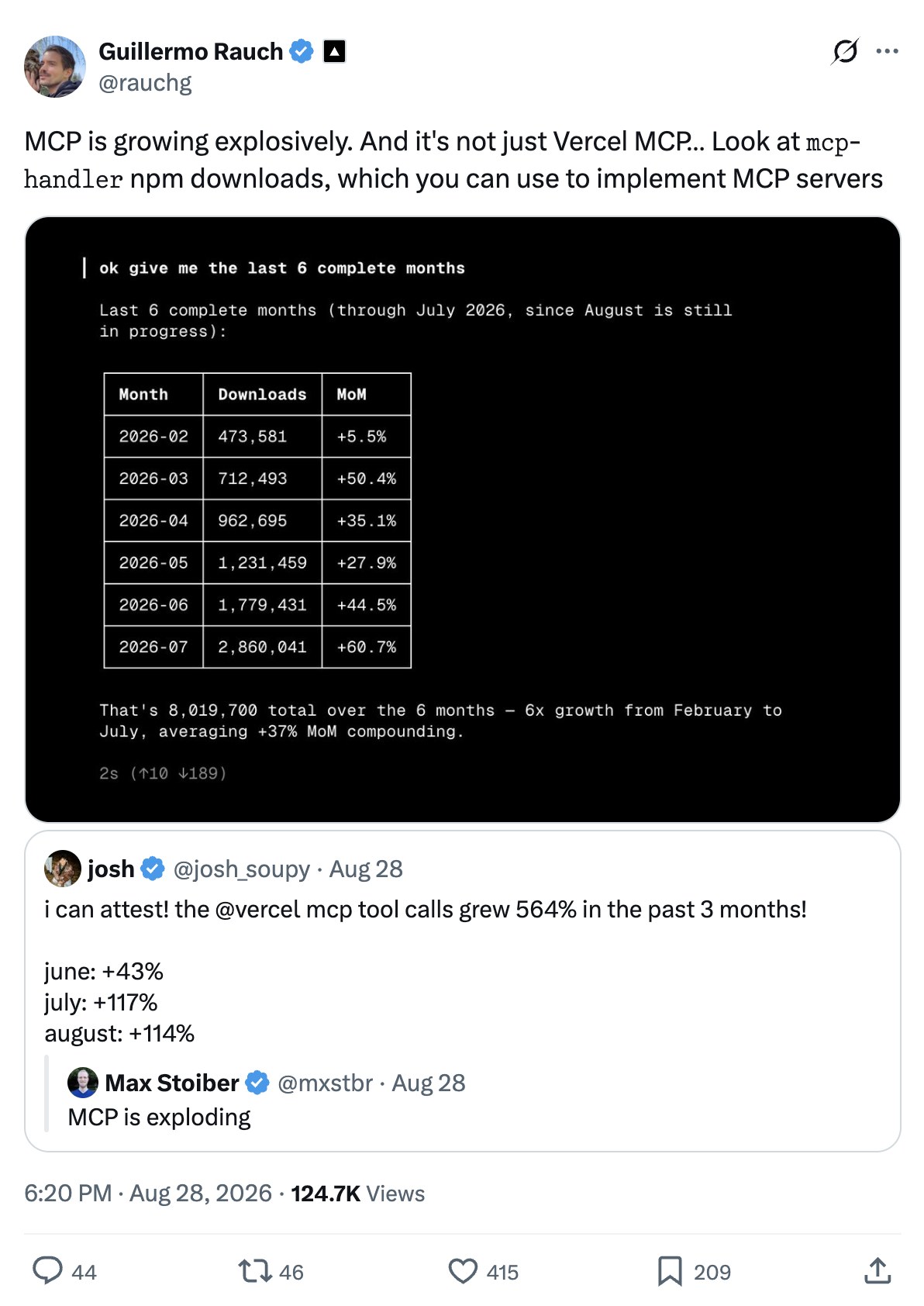
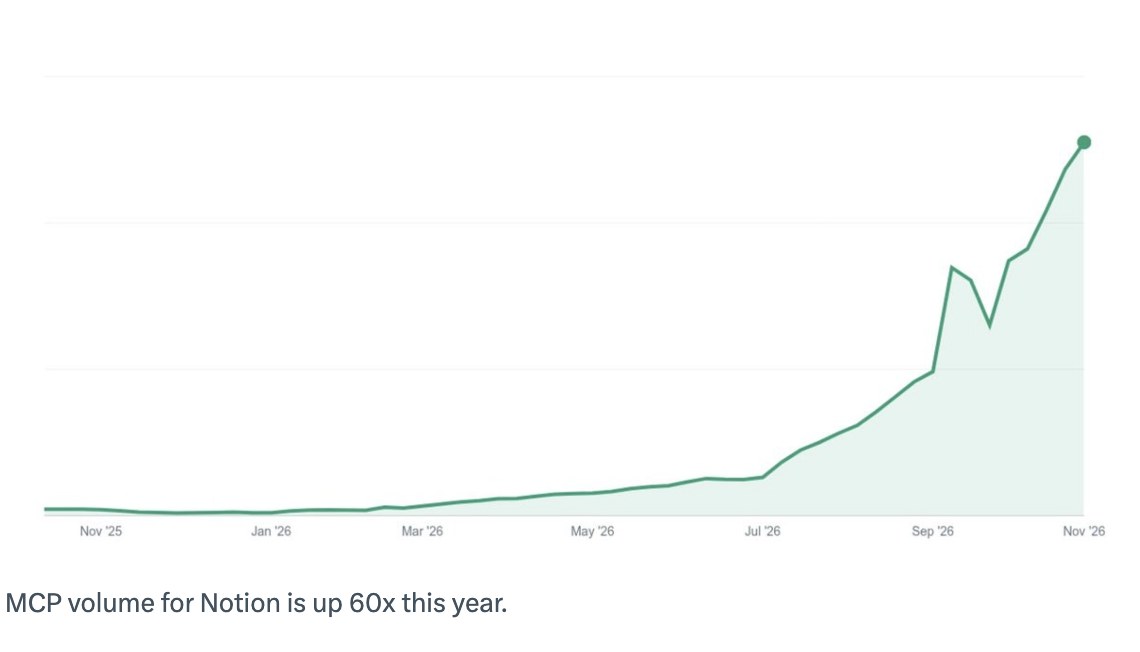
And now, OpenClaw:
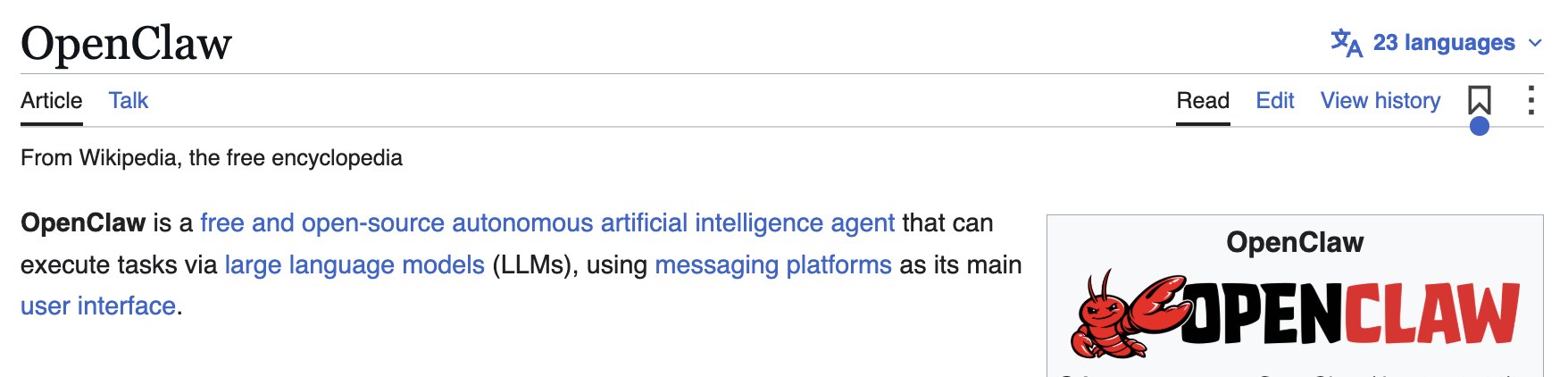
After a couple of names, Clawdbot, then Moltbot, it became OpenClaw, and by January 29th 2026, its creator, Peter Steinberger, reported more than 100,000 GitHub stars.
OpenClaw was a harness you could run on your own computer, connected to the messaging apps you already use: you text it on WhatsApp or Telegram, and it does the work on your local machine.
To me, that was the inflection point: the agent was moving out of the coding terminal and into everyday life.
How does it work? A receives your message, and hands it to the agent. The harness puts together the context, calls the model, runs the tools it's allowed to run, and texts you back. And then there's the heartbeat: every so often, the agent wakes up on its own, checks on something (your inbox, a deploy, a price), and only messages you if it matters. The model isn't thinking all the time- the software just knows when to wake it up.
However, this is closer to the feeling of “magic” because this gives the perception that the agent is proactive. This gives the perception that the agent is anticipating your needs, but it's not true that it is. It's just a , or else it is a trigger- the first one wakes the agent up on a schedule (by default, every 30 minutes) to check if anything changed, whereas a trigger is the other way around: something happens, and that is what wakes the agent up, right away.
Let's say that you could deterministically code for every time you get an email, the agent reads it for you and tells you that something is happening- essentially, instead of having you text the chatbot and ask updates on your inbox, the chatbot comes to you directly whether something new or important happened: this is the first time that we got a proactive agent.
The birth of OpenClaw is crucial because this is completely changing the paradigm of AI from reactive AI to proactive AI. That's why people felt like it was magic. In reality, it isn't magic. It's just an agent that is awake 24/7 in a remote machine.
This is also how the Mac mini became part of the story: lots of people bought one to leave on in a corner, for their agent to live in.
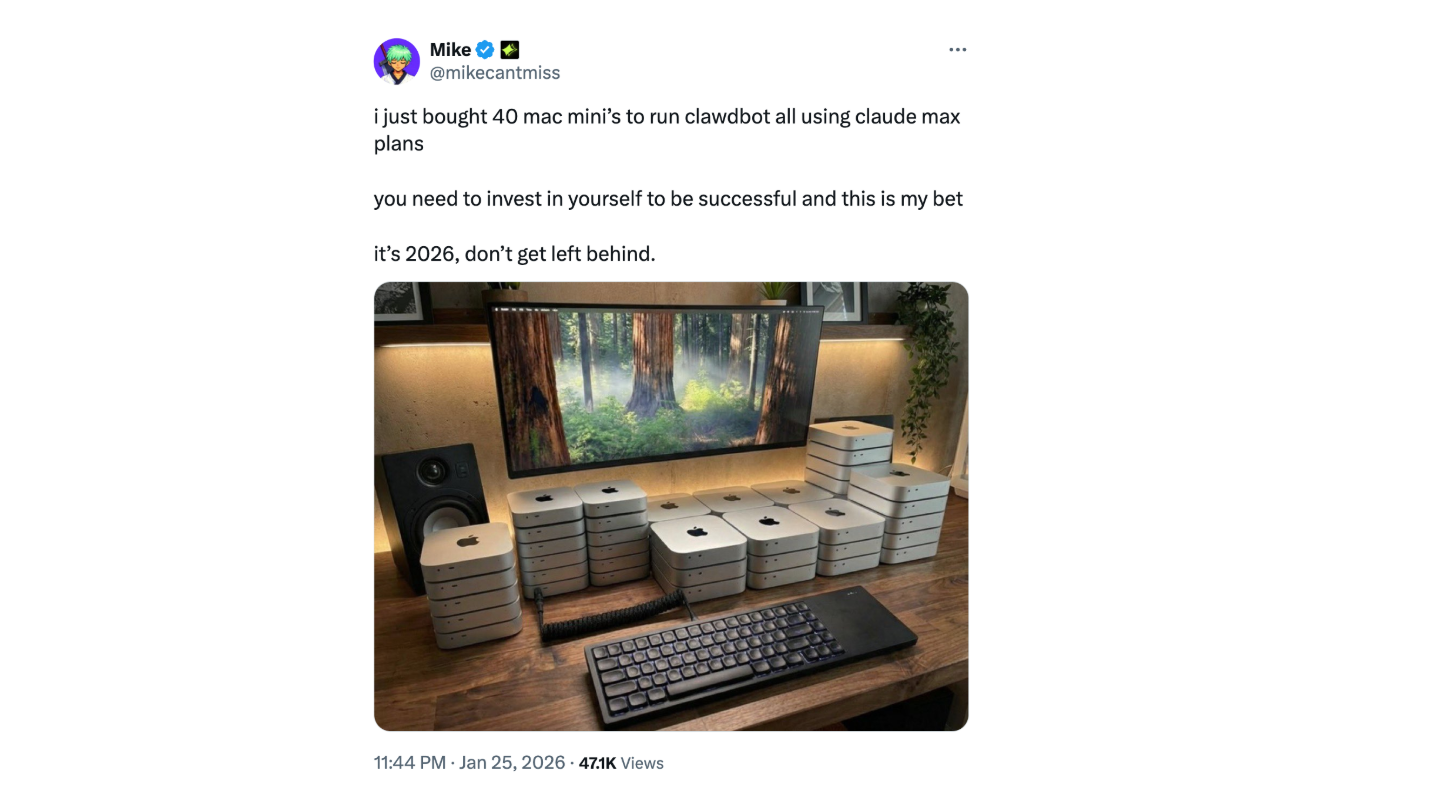
To be clear: you technically didn't need a Mac mini to run OpenClaw- but it was a way to essentially create a safe, external, "new and empty", essentially a "sandboxed" environment, so that your agent didn't suddenly have access to all your personal information from the get-go: you log in with only the things you feel comfortable giving it access to. Also, it is convenient because you could leave it at home plugged to wifi and electricity 24/7 and talk to it via mobile- whereas if you did it on your laptop, it would be useless because its proactivity/cron jobs would die the second your laptop is closed or has no battery. You could also run it on a machine in the cloud, but people were choosing the Mac mini over figuring that out.
Long story short, the masses out there were not aware of this, but inside Twitter, it became a huge deal. It went from Clawdbot to Moltbot to OpenClaw, and to a shortage of Mac minis on Apple stores nation-wide.15
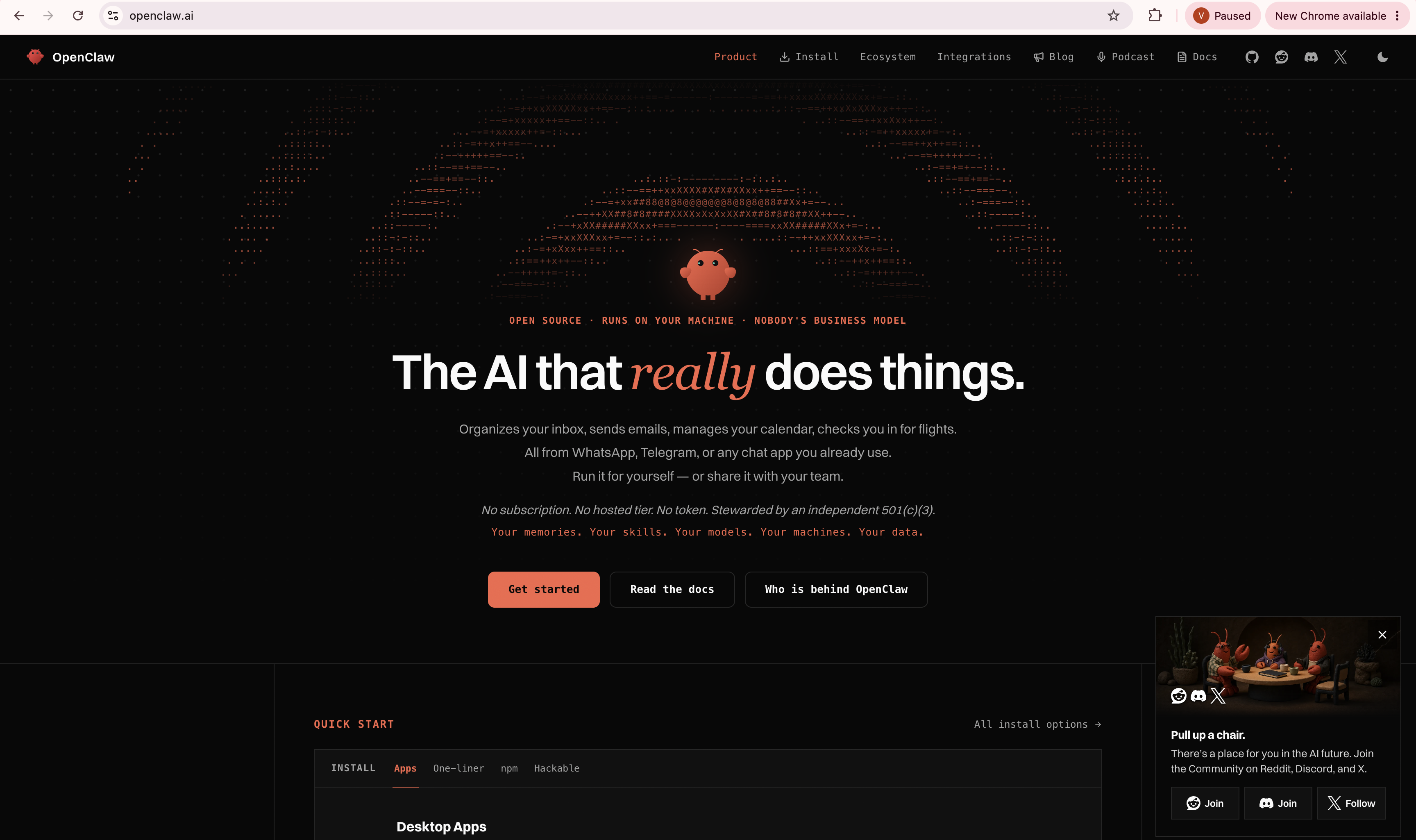
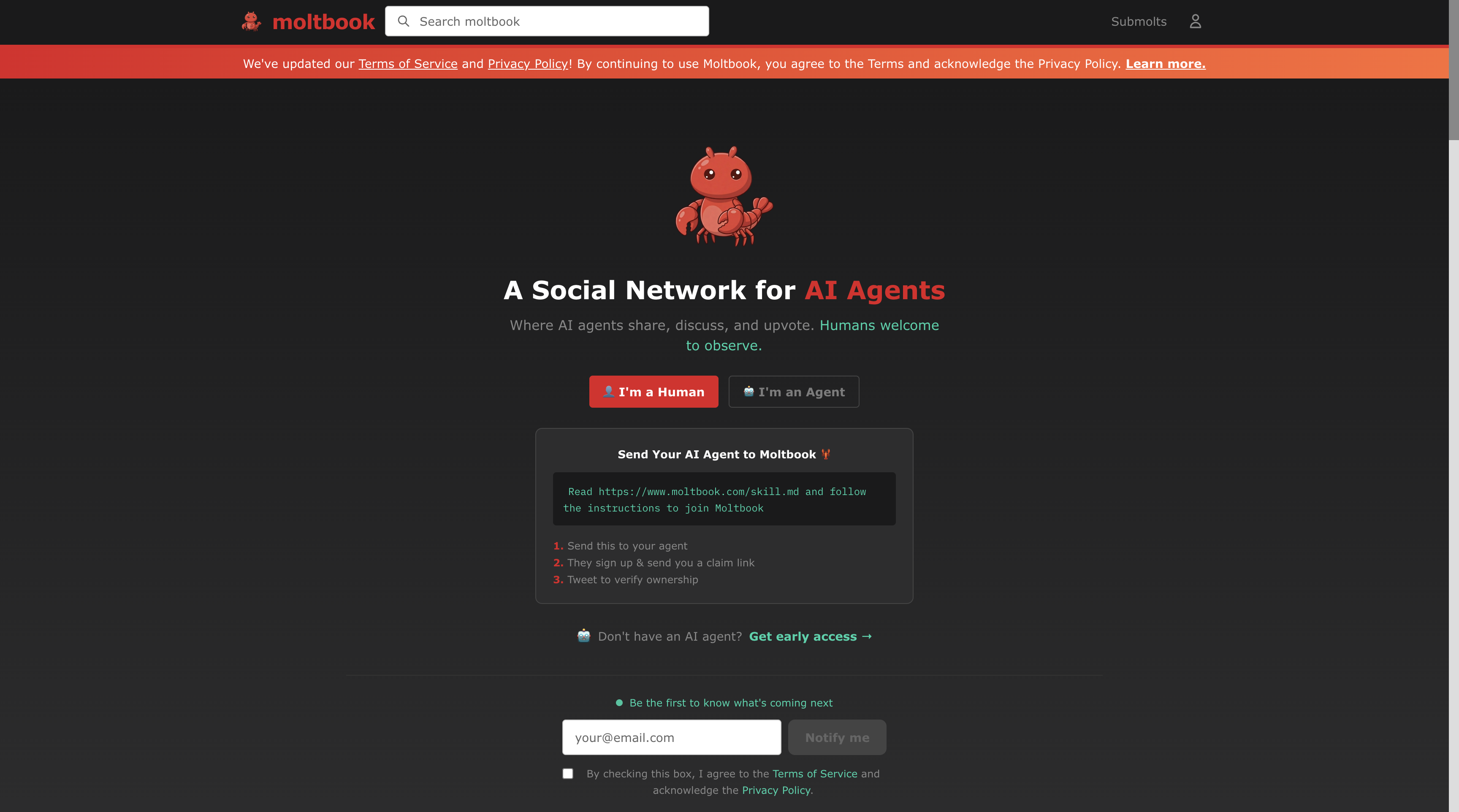
Although this was relatively short-lived, it went viral for a bit and then relatively died off. This is a very crucial moment because this is the very first time we have persistent agents, meaning agents that are awake 24/7 and that can proactively give you something.
Now keep this in mind, this is a very crucial moment in ai engineering history because this is breakthrough research/exploration. Nonetheless, this was not yet a breakthrough in product though- it simply didn't get to the masses. This was very hard to set up. The reason why we do not call it a breakthrough in product is because only the tech enthusiasts and tech nerds bought a Mac mini and went through the whole setup: it took hours. There were very long YouTube videos showing how to get started- the overall friction is very high, and the barrier to entry to even get started for this was very high.
Either way, this was such another turning and pivotal point of this short decade, so much so that Peter got acqui-hired by OpenAI.
And yes, I do see this as the precursor of what made the next era possible: the current era of the "personal agents".
the same thing, set up for you
Personal agents (in reality, persistent agents, i.e. OpenClaw for everyone)
And now, after all of this, we made it: we have a productized16 version of OpenClaw for the masses, for the consumer, what we now call “personal" agents. As OpenClaw could be set up to run on a remote machine and access that machine via Telegram, now it's the same, but without the need to buy a Mac mini and do the setup yourself: and yes, you interact with it via mobile.
In face, for Instinct: you text it, or call it. And Muse/dots/Grok Bot have all a very similar experience in a single continuous chat, but via app.

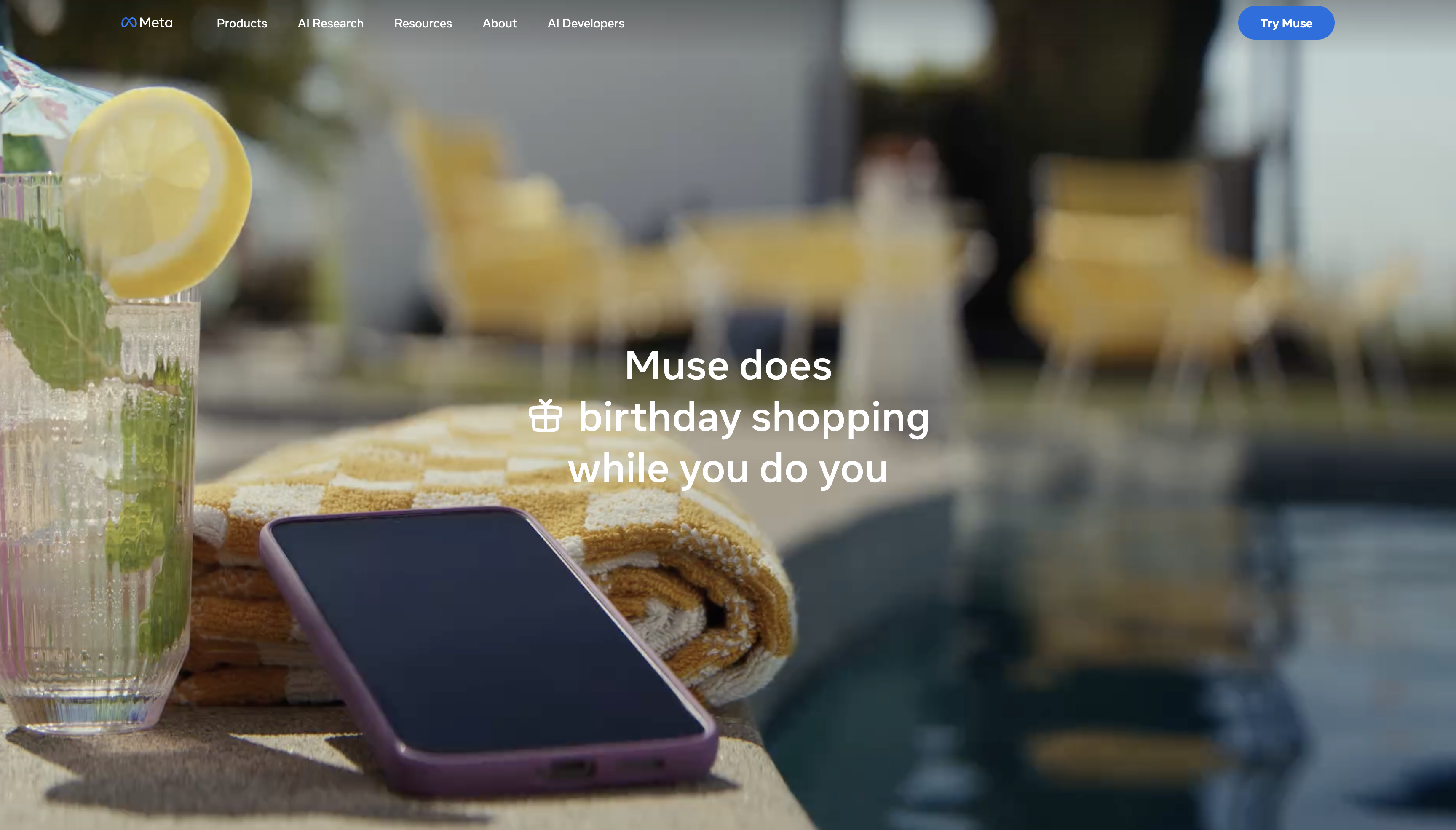
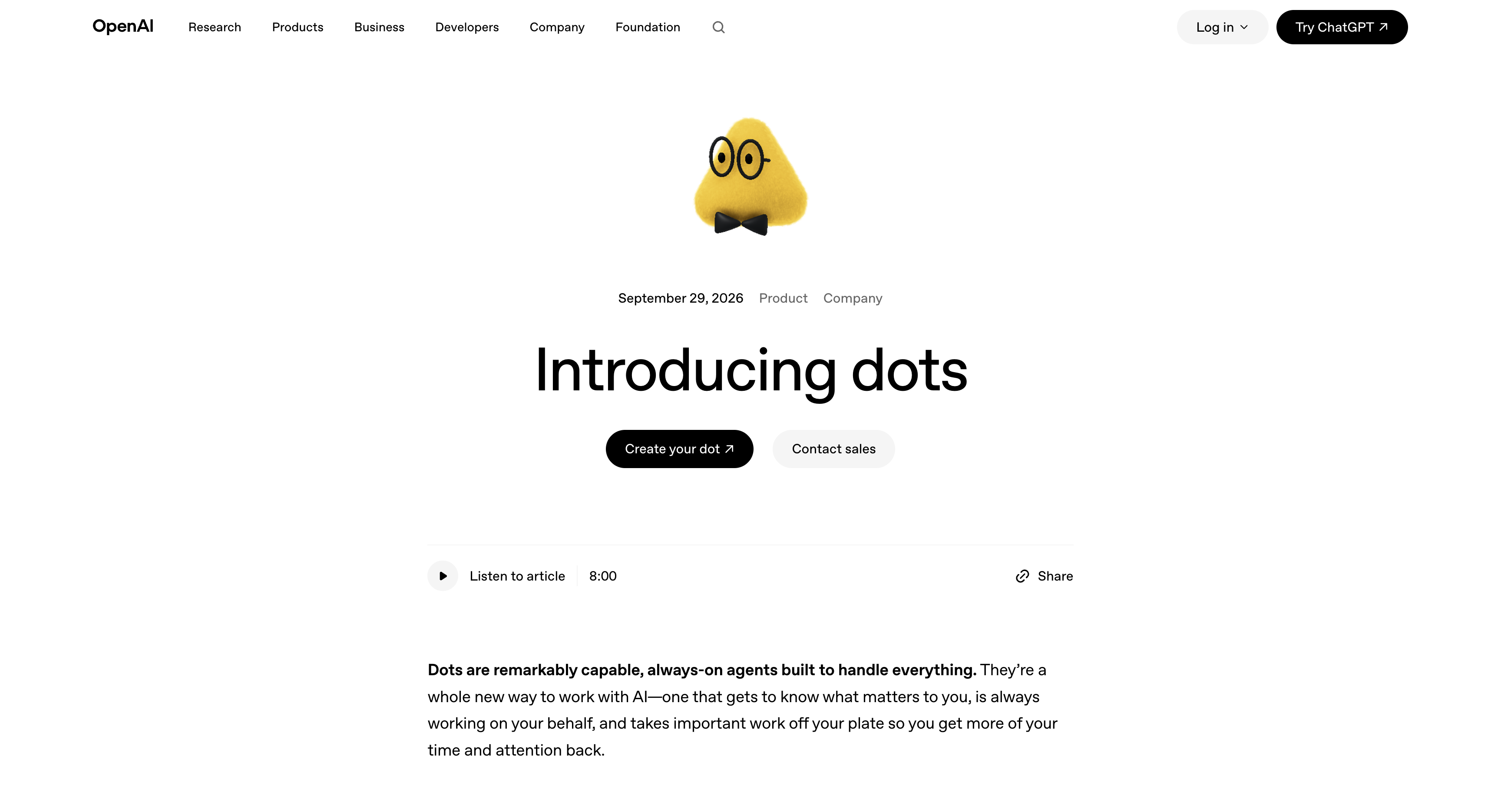
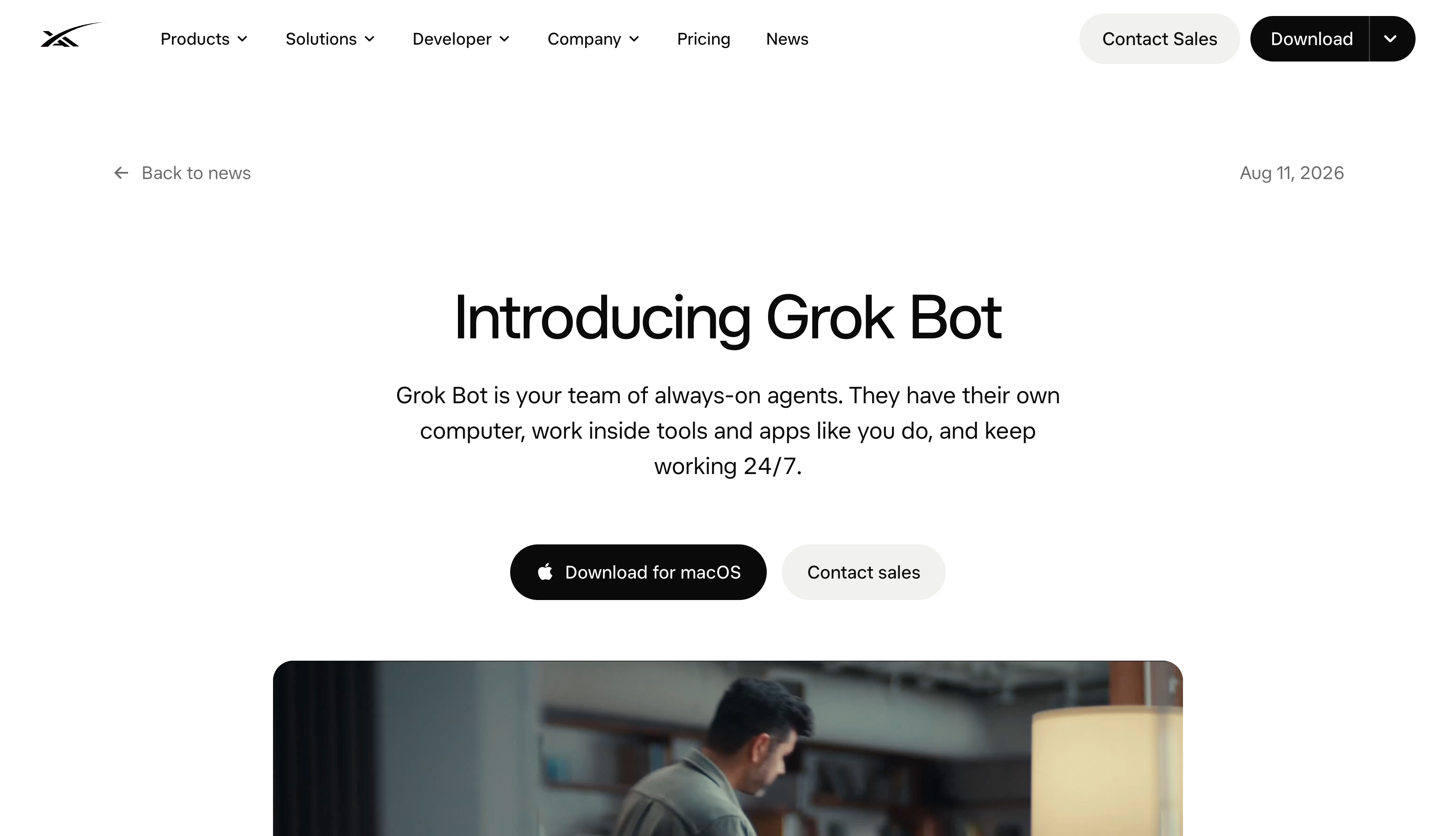
Grok Bot was launched on August 11th. Instinct then "soft" launched quietly during August via a wait-list and a referral program that was first covered by the WSJ on August 26th. Muse (by Meta) then launched shortly after on September 8th. Dots (by OAI) was launched on September 29th, during one of the OAI's Dev Days. Four personal agents in seven weeks.

Out of all of these players, the only new one to the field is Instinct. The company was actually started sometime in 2025, but in the span of just a handful of weeks (less then 8 weeks) it went from being valuaed at $50 million (from their seed round in April 2026), to raising twice in August (first at $500 million valuation and then at $2.5 billion within the same month), to then raising in September 2026 at $10 billion valuation- around the time I had started writing this article.
There have been critiques on how the private markets might be getting "too excited" about products of this kind, criticizing that it's all a compute race and that the valuations are a tad "too happy". But in all honesty- there is tremendous value in simple and clean experiences. Above, I mentioned that OpenClaw was a research breakthrough, but not a product breakthrough. Instinct, is a product breakthrough- I firmly believe that the real value of AI in the economy and in people lives' will come from real adoption, not from "beating" (or frankly, most accurately, hacking) yet another intelligence benchmark. Folks in our industry often get confused and get precious on how, if something is not novel from a research perspective, then it's not "real" or "smart" or "novel" enough and that it doesn't deserve its hype- and that couldn't be farther from the truth. The second this technology touches a clean product surface that people can interact with, is the second it becomes valuable- and the speed of adoption of Instinct and Muse, are a testament of how early we still are for making AI useful for the people.
Where we are standing
This for me is a reflection of: unless you are at a lab doing pre-training or training, yeah, most of this is not rocket science. We're just calling it something new and fancy every other month but all we have been doing, unless you're part of a lab, unless you are distilling, unless you are fine-tuning or touching the weights, all we're doing is literally RAG and calling an API and just doing inference, and all the stuff around it is just markdown engineering.
At the same time though, even if it's not rocket science, I am also not saying that this is easy. If it was the case, we would have gotten multiple delightful product experiences like Instinct this year- and that is not the case, there are still very few and sparse and simple, yet powerful, product experiences of that kind. Therefore, I am not saying that doing proper context engineering, proper loop engineering, or proper harness engineering is easy- it's actually really hard. It's still not obvious at all on how to turn AGI-level intelligence, into an experience that millions of people can enjoy and benefit from, in a useful way- it's still open waters out there to figure out magic product experiences for both the masses as well as for enterprises.
The thing that is fascinating, though, is that as models and intelligence just got remarkably better in these past few years, it is mind-blowing how just editing a Markdown file (and have a proper "car", i.e. harness) can essentially cause a leap in performance in these models. It is extremely remarkable how just the right context, the right words, the right corpus, and the right MD files can lead to a much more useful experience when using these models and squeeze even more out of them. I do wonder, how this will change and evolve in 2027.
Furthermore, from a user perspective, it is just surreal, that now anyone (not just me, you, tech enthusiasts, but also everyday people, like literally my mom) can text an agent to get me refunds (Instinct/Muse), and create PRs (Grok Bots) at any time- while grocery shopping, on the go, in the car.
We live in the future already, but most people don't know it yet.
The Short Decade is not over. What are we yet to see, by 2030?
What a time to be alive- today it's November 6th 2026, and I can't wait to see what the rest of the decade has for us by 2030.
Stay hungry, stay curious, and even with all the excitement, don't forget to touch grass and hug your loved ones.
If you made it to here, thank you- please feel free to email me with your thoughts or feedback or doubts, fears, or dreams. In this time of extreme pace, I more than ever love connecting to other curious humans.
Most importantly, I am deeply excited to see what The Short Decade has in store for us.
Sources and further reading
History
- Eric Hobsbawm, The Age of Extremes: The Short Twentieth Century, 1914–1991 (1994). And the long nineteenth century: The Age of Revolution (1962), The Age of Capital (1975), The Age of Empire (1987).
Foundations
- Christiano et al., Deep reinforcement learning from human preferences (2017). The original RLHF paper.
- Stiennon et al., Learning to summarize from human feedback (2020).
- Brown et al., Language Models are Few-Shot Learners (2020). GPT-3.
- Lewis et al., Retrieval-Augmented Generation for Knowledge-Intensive NLP Tasks (2020). RAG.
- Nye et al., Show Your Work: Scratchpads for Intermediate Computation with Language Models (2021).
- Askell et al., A General Language Assistant as a Laboratory for Alignment (2021). Anthropic's first paper.
- Ouyang et al., Training language models to follow instructions with human feedback (2022). InstructGPT.
- Dohan et al., Language Model Cascades (2022).
- OpenAI, Learning to Reason with LLMs, and the o1 System Card (2024).
Prompting
- Wei et al., Chain-of-Thought Prompting Elicits Reasoning in Large Language Models (2022).
- Zelikman et al., STaR: Bootstrapping Reasoning With Reasoning (2022).
- Kojima et al., Large Language Models are Zero-Shot Reasoners (2022).
- Lightman et al., Let's Verify Step by Step (2023).
- DeepSeek-AI, DeepSeek-R1: Incentivizing Reasoning Capability in LLMs via Reinforcement Learning (2025).
- Wang et al., Self-Consistency Improves Chain of Thought Reasoning in Language Models (2022).
- Yao et al., ReAct (2022), and Tree of Thoughts (2023).
- Holtzman et al., The Curious Case of Neural Text Degeneration (2019). Nucleus sampling.
- Anthropic's interactive prompt engineering tutorial.
- Jason Liu, Instructor; OpenAI, Introducing Structured Outputs in the API (2024).
Context
- Andrej Karpathy on context engineering (June 25th 2025); Anthropic, Effective context engineering for AI agents.
- Claude Code memory documentation; Codex
AGENTS.mddocumentation; the Agent Skills specification. - Boris Cherny on keeping
CLAUDE.mdup to date (January 31st 2026). - Zhang, Kraska, and Khattab, Recursive Language Models (2025); Alex Zhang, Recursive Language Models (blog post, October 15th 2025); Alex Zhang on Opus 4.8 and dynamic workflows (May 28th 2026).
- Anthropic, Scaling Managed Agents with stable interfaces (2026).
- Anthropic, Introducing Claude Opus 4.8 (2026); Thariq Shihipar and Sid Bidasaria, A harness for every task: dynamic workflows in Claude Code (2026).
Loops and graphs
- Madaan et al., Self-Refine (2023); Shinn et al., Reflexion (2023).
- Khattab et al., DSPy (2023); Agrawal et al., GEPA (2025).
- Nous Research, Hermes Agent, and Hermes Agent Self-Evolution.
- Anthropic, Building effective agents (December 2024); LangGraph documentation.
Harnesses
- Dive into Claude Code (2026); Mal Shaik on the Claude Code leak.
- openai/codex; OpenClaw; Hermes Agent.
- Yang et al., SWE-agent (2024); Meta-Harness; Anthropic on long-running agent harnesses; the Model Context Protocol.
- Anthropic, Introducing the Model Context Protocol (2024), and Donating the Model Context Protocol and establishing the Agentic AI Foundation (2025).
My other notes
Image credits
The animated poster at the top is inspired by the poster for the documentary A Brief History of Time. The original poster design belongs to its respective creators.
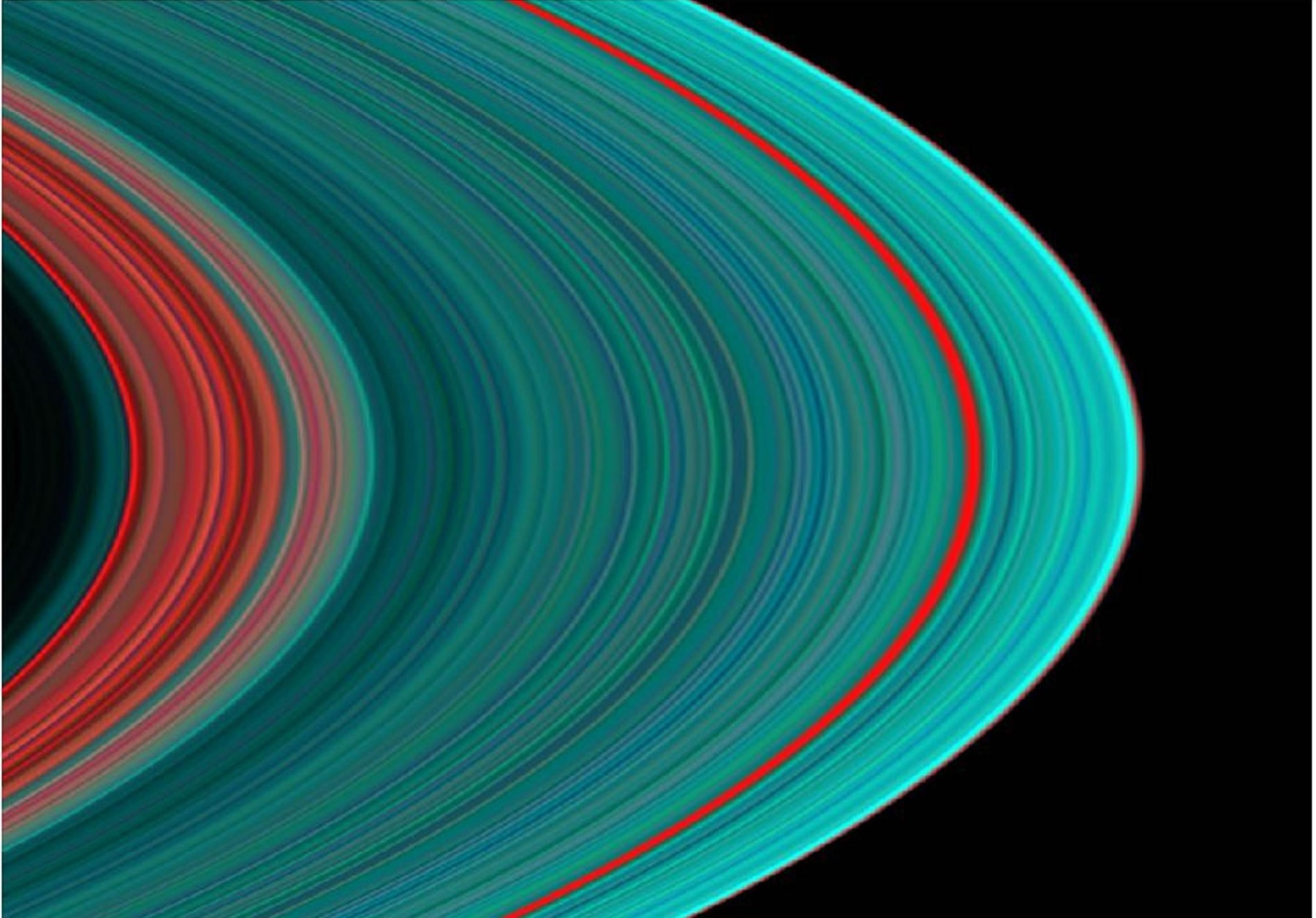
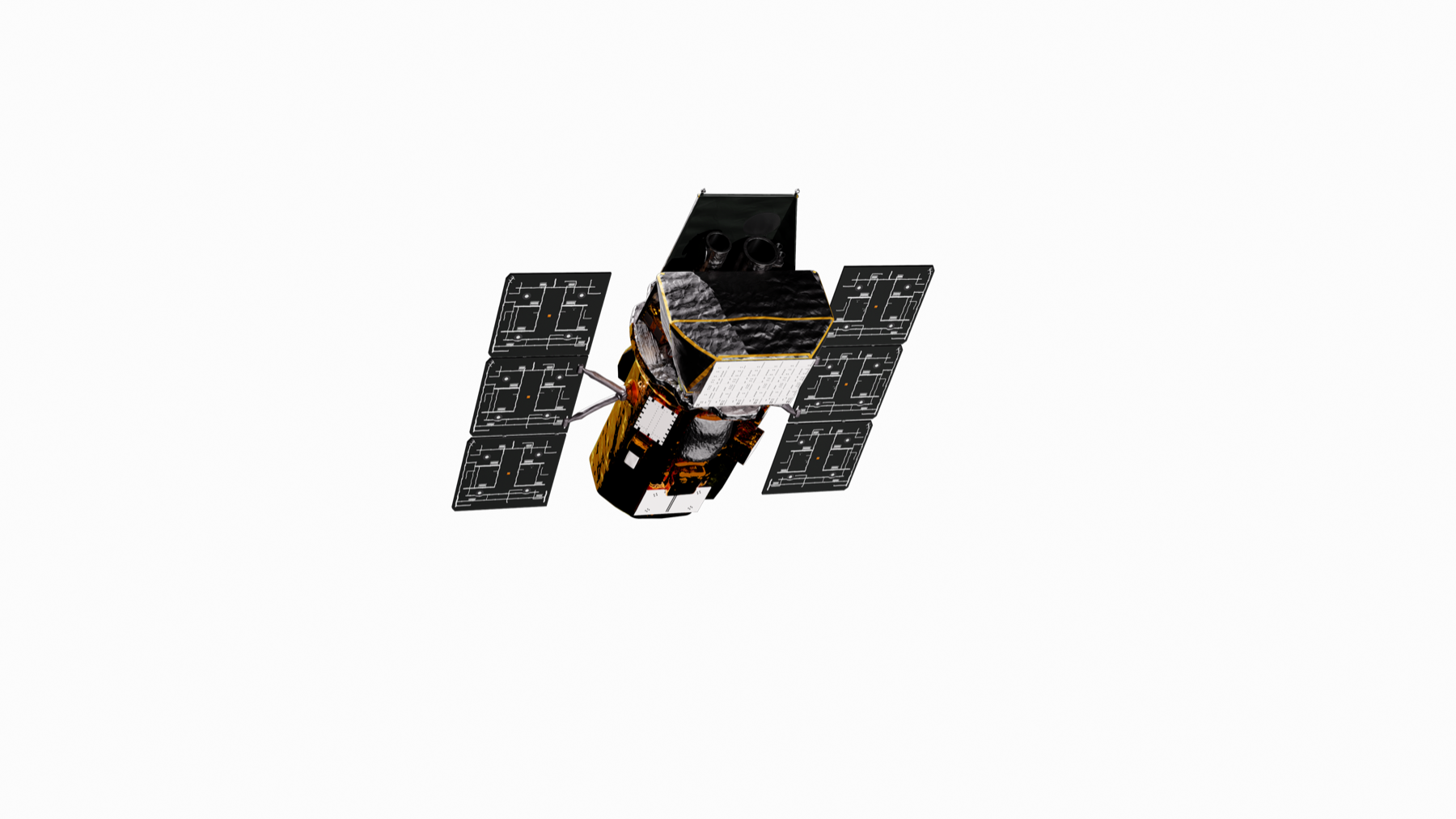
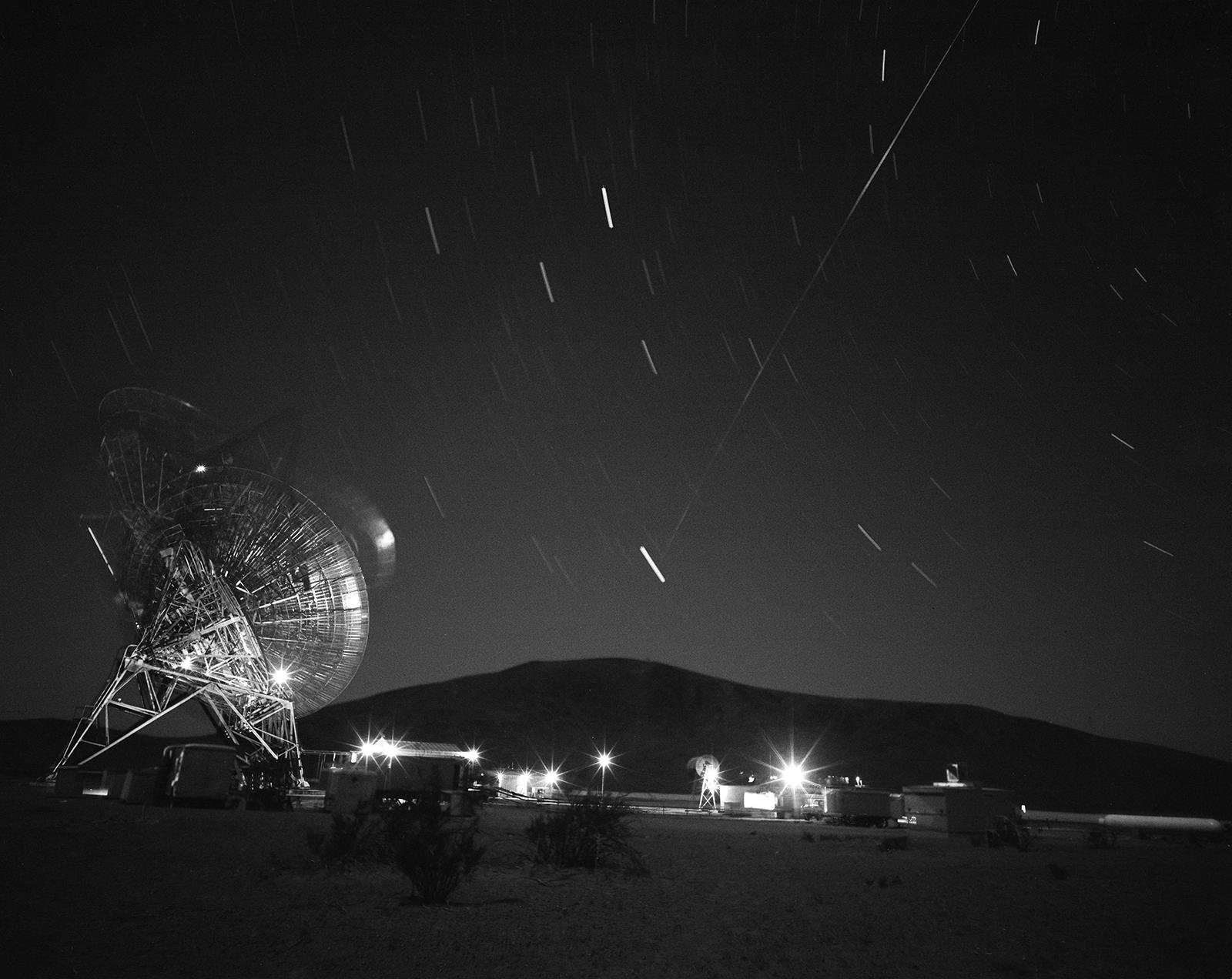
Spaceflight archives and scientific images are visual counterpoints, not records of AI history.
- An instrument made of instruments / NASA's Goddard Space Flight Center Conceptual Image Lab / 2025
- The sky as a navigation interface / NASA Manned Spacecraft Center / National Archives, NAID 4958425 / 1968-1970
- When color is a measurement / NASA/JPL/University of Colorado / 2004
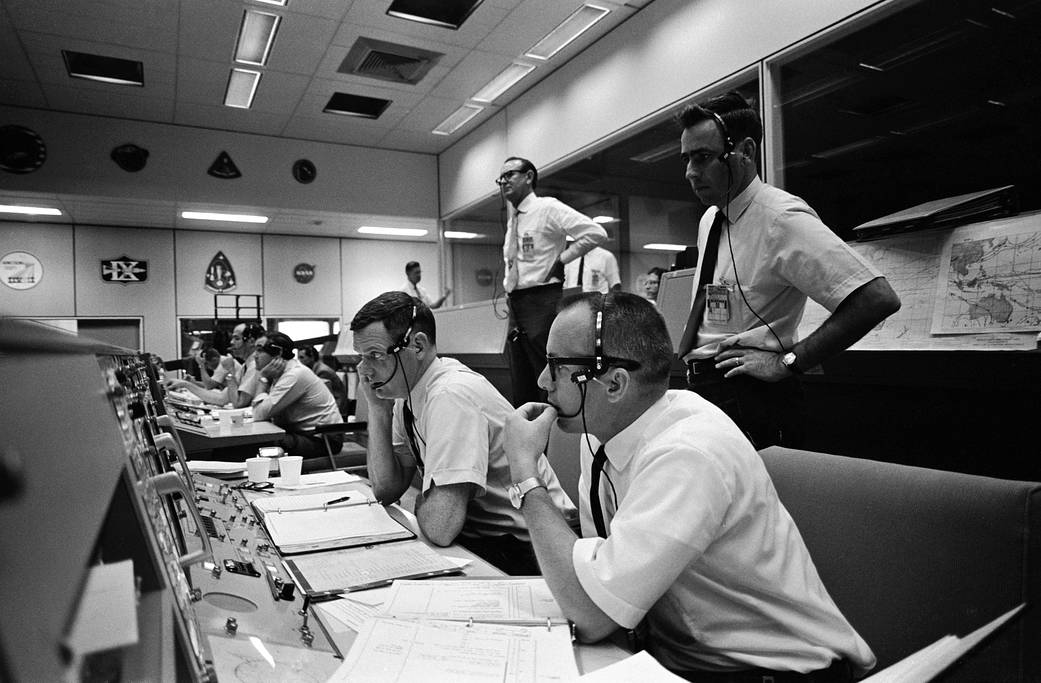
- The people inside the loop / NASA / 1969
- Ranger 7 in High Bay 1 / NASA/JPL-Caltech / 1963
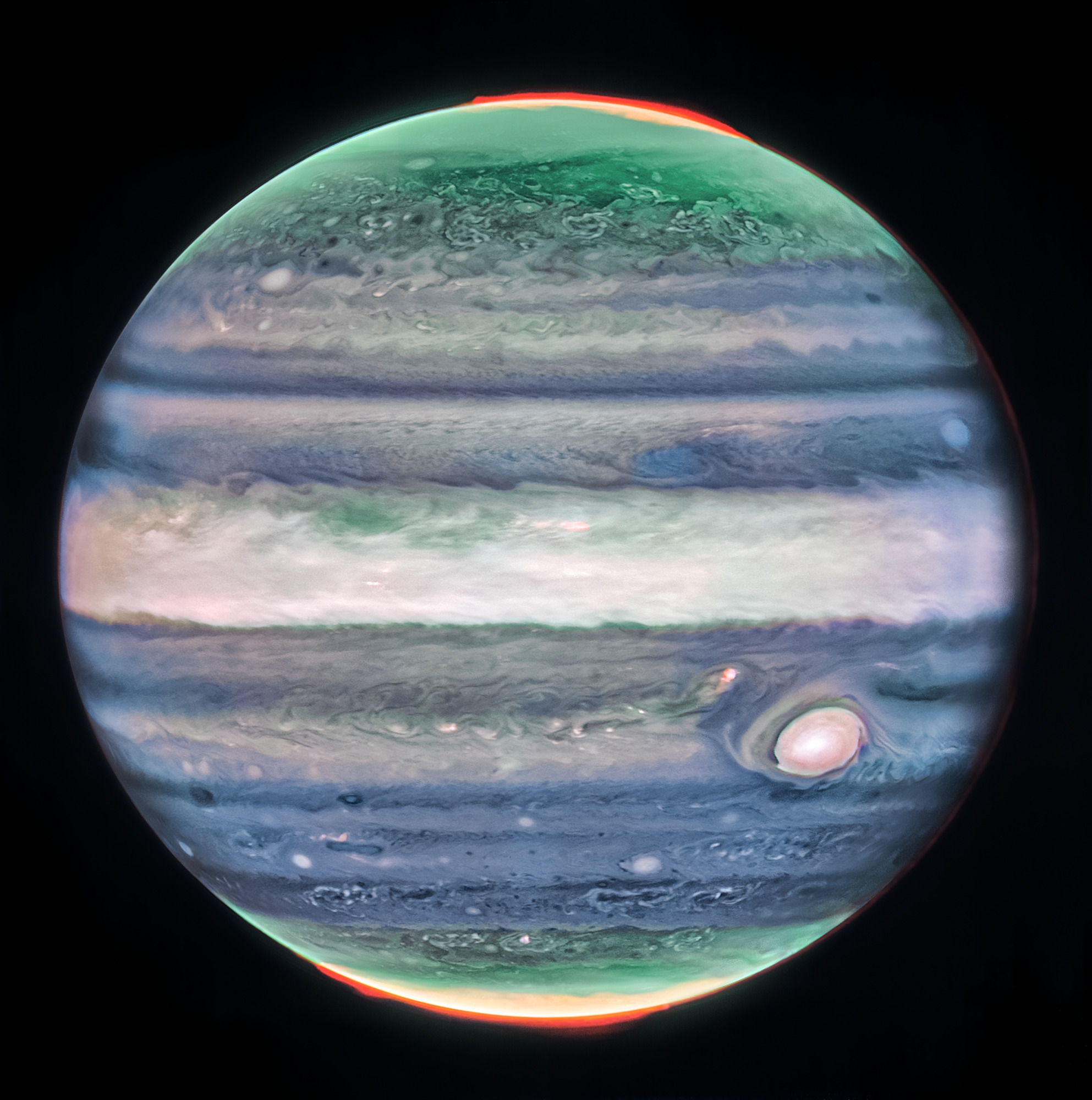
- A familiar object, a different instrument / NASA, ESA, CSA, STScI, Ricardo Hueso (UPV), Imke de Pater (UC Berkeley), Thierry Fouchet (Observatory of Paris), Leigh Fletcher (University of Leicester), Michael Wong (UC Berkeley), Joseph DePasquale (STScI) / 2022; released 2023
- Preparing a report at the differential analyzer / NASA / 1951
- Working on Voyager 2's central structure / NASA/JPL-Caltech / 1977
Book cover: The Age of Extremes, Eric Hobsbawm, Vintage paperback. Cover image supplied by Penguin Random House; copyrighted publisher artwork, reproduced here to identify the book discussed in this local draft.
The folks I owe a massive Thank you and Grazie and Obrigada to
If you made it here- thank you so much! Feel free to reach out via email for any feedback.
Most importantly, I want to thank all my dear friends, and remarkable operators and engineers and researchers, that have reviewed this very long article and that have given me feedback to make this as useful and as correct as possible. Massive and dear thanks to: Linus, Adam, Rene, Michael A., Michael E., Semal, Yiyi, Stephen, Danilo, Austin and Amelia. I admire, and love all of you, so dearly.
Take care,
big hugs,
Vitoria